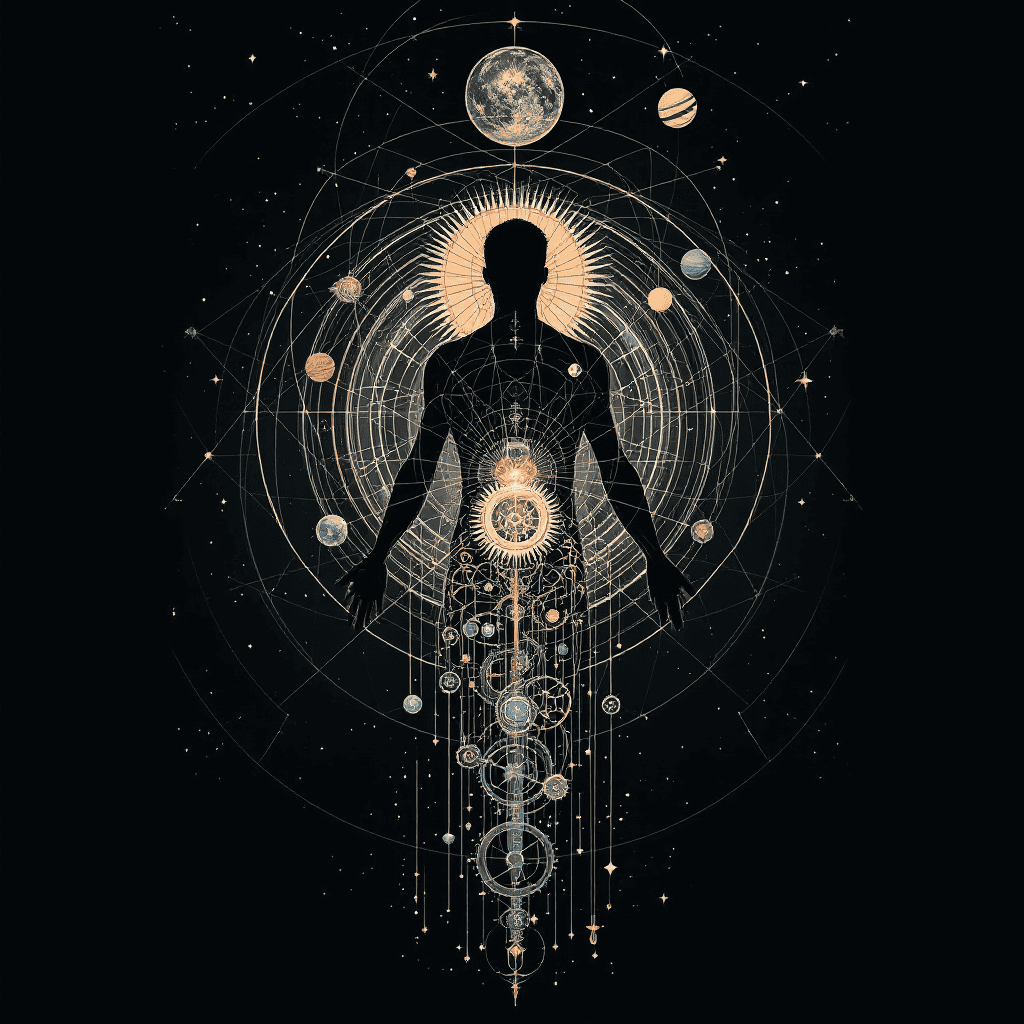
Circadian rhythm and astrology share a hidden connection that most people never consider. Your body runs on an internal clock that responds to light, darkness, and cycles beyond the visible spectrum. Ancient astrologers mapped those same cycles through planetary motion, treating the heavens as a timing system that influenced not just seasons but the rhythms inside living organisms. Modern science now confirms what those early observers suspected: celestial patterns correspond with biological ones, and the mechanisms behind both may be more interconnected than previously acknowledged.
The circadian rhythm is your body’s 24-hour cycle, governing sleep, hormone release, body temperature, and alertness. It responds primarily to sunlight, but emerging research suggests it also registers subtler environmental signals, including magnetic field variations and gravitational shifts. Astrology, stripped of pop-culture horoscopes, functions as a symbolic map of those environmental shifts. It tracks planetary positions not as controllers of fate but as markers of recurring energetic conditions. Where modern chronobiology measures the body’s response to time, ancient astrology mapped time itself as a patterned force.
The Science Behind Your Biological Clock
Circadian rhythms exist in nearly every living organism, from bacteria to humans. They are driven by clock genes inside cells that oscillate on roughly a 24-hour cycle. The suprachiasmatic nucleus, a tiny region in the brain’s hypothalamus, acts as the master clock. It receives input from the eyes, synchronizing internal time with external light. When sunlight hits the retina, signals travel to this master clock, suppressing melatonin production and triggering wakefulness. As darkness falls, melatonin rises, and the body prepares for rest.
But the circadian system does not respond to light alone. Research in magnetobiology has shown that Earth’s magnetic field influences circadian function. Cryptochrome proteins, the same molecules involved in circadian regulation, also respond to magnetic fields. Studies conducted in controlled environments reveal that even subtle magnetic field shifts can alter sleep quality, hormone timing, and mood regulation. The body is not isolated from cosmic forces. It registers them continuously.
This is where circadian rhythm and astrology begin to converge. Astrology does not claim that planets control your sleep schedule. It proposes that planetary alignments correspond with measurable environmental conditions, gravitational harmonics, electromagnetic fluctuations, and solar activity, that create recurring patterns. Those patterns influence biology the same way seasonal shifts do. The ancients encoded this knowledge symbolically. Modern science is beginning to decode it mechanically.
Planetary Cycles as Environmental Timestamps
Astrology functions as a calendar of cosmic conditions. Planetary positions mark recurring environmental states rather than causing them directly. The Sun governs the daily cycle. The Moon governs the monthly one. Together they create tidal rhythms, lunar phases, and seasonal transitions. Ancient cultures used these markers to time planting, harvests, rituals, and rest periods. They observed that human behavior, mood, and health followed similar rhythms.
The Moon’s influence on circadian rhythm is well documented. Studies show that sleep patterns shift during the full moon, with people sleeping less and experiencing more fragmented rest. Melatonin levels drop slightly during lunar peaks. This is not superstition. It is measurable biology. The Moon’s gravitational pull affects ocean tides and atmospheric pressure. If it moves trillions of gallons of water, the idea that it influences the fluid systems inside the human body is not far-fetched.
Solar cycles operate on longer timelines. The Sun’s 11-year activity cycle correlates with geomagnetic storms, which have been shown to influence heart rate variability, mood disorders, and even hospital admission rates. Astrology maps these solar and lunar rhythms as archetypal patterns. The Sun represents vitality and conscious energy. The Moon represents emotion and subconscious rhythm. The interplay between them mirrors the body’s own oscillation between wakefulness and rest, action and reflection.
What astrology adds is granularity. While chronobiology focuses on the 24-hour cycle, astrology maps longer cycles and their intersections, tracking how planetary transits correspond with shifts in energy, focus, and emotional baseline. These are not mystical claims. They are pattern observations that modern science is only beginning to measure with precision.
The Pineal Gland, Melatonin, and Cosmic Timing
The pineal gland sits at the center of circadian regulation. This small, pinecone-shaped gland deep in the brain produces melatonin, the hormone that signals sleep. It responds to light detected by the eyes, but it also contains magnetite crystals, microscopic iron-based structures that respond to magnetic fields. This makes the pineal gland not just a light sensor but a potential magnetic field sensor as well.
Ancient traditions called the pineal gland the seat of the soul. Modern science calls it the circadian pacemaker. Both descriptions point to the same function: it translates external timing signals into internal biological rhythm. The pineal gland does not operate in isolation. It responds to the full spectrum of environmental input, including electromagnetic frequencies, lunar phases, and seasonal light variations.
Astrology has always emphasized timing. The natal chart, calculated from the exact moment and location of birth, captures a snapshot of planetary positions at that instant. Those positions correspond with specific gravitational and magnetic conditions on Earth. If the pineal gland and circadian system are sensitive to those conditions, then the birth moment may imprint a baseline rhythm, a default energetic signature that persists throughout life. This is not determinism. It is environmental imprinting, the same principle that explains why season of birth correlates with certain health and behavioral tendencies in large population studies.
The mechanism behind how the pineal responds to cosmic timing is still under investigation. REDACTED, READ CHAPTER 8, but the correlation between geomagnetic activity and melatonin secretion has been documented repeatedly. The pineal gland bridges the visible and invisible, translating light into hormone signals and possibly translating subtler cosmic rhythms into biological ones.
How Astrological Transits Mirror Biological Rhythms
Astrology organizes time into repeating cycles. The Sun returns to the same position once a year, creating the solar return used in birthday chart readings. The Moon cycles every 29.5 days. Saturn completes its orbit every 29 years, marking major life transitions. These are not arbitrary intervals. They correspond with measurable planetary motion and, by extension, with recurring environmental conditions.
Consider the Saturn return, the astrological event that occurs around age 29 and again at 58. Many people report major life shifts during these windows: career changes, relationship endings, identity restructuring. Astrologers interpret this as a maturation cycle. Neuroscience offers a parallel: the prefrontal cortex, responsible for decision making and impulse control, completes its development around age 25 to 30. The timing overlap is not coincidental. Both systems describe a developmental threshold.
Daily astrological transits function similarly. As planets move through different signs and houses, they mark shifts in environmental emphasis. A Mars transit might correspond with increased physical energy or agitation. A Venus transit might correlate with social openness or creative flow. These are not mystical forces acting on the individual. They are symbolic markers of conditions that affect everyone within a given environment, just as a cold front affects mood and energy without singling out individuals.
Circadian rhythm and astrology both operate on the principle of resonance. The body synchronizes with external cycles because it evolved within them. Disconnection from those cycles, through artificial light, irregular sleep, or environmental disruption, produces circadian dysregulation. Astrology proposes that similar dysregulation occurs when individuals ignore or resist the timing signals encoded in longer planetary cycles. Practices tied to lunar timing and fasting windows reflect this principle, using celestial markers to optimize biological function.
Ancient Systems That Tracked Both
Ancient cultures did not separate astrology from biology. They treated the two as inseparable. Egyptian priests tracked the heliacal rising of Sirius to predict the Nile’s flooding, synchronizing agriculture with celestial events. They also used astrological timing to guide medical treatments, believing that different organs corresponded with different zodiac signs and that treatment effectiveness varied with planetary position.
Traditional Chinese Medicine operates on a similar premise. The body’s meridian system follows a 24-hour cycle, with each organ receiving peak energy during a specific two-hour window. This is called the Chinese body clock. It mirrors circadian rhythm but adds a layer of specificity. The liver detoxifies between 1 and 3 a.m. The lungs peak between 3 and 5 a.m. Waking consistently during a particular window suggests imbalance in the corresponding organ system.
This system integrates with lunar and solar cycles as well. Acupuncture texts reference planetary positions and seasonal timing when prescribing treatments. The logic is consistent: the body is a microcosm of the macrocosm. Internal rhythms reflect external ones. Healing requires alignment with both. Modern chronotherapy, which times medication delivery to circadian phases for maximum effectiveness, operates on the same principle. The language has changed. The insight has not.
Ayurveda, the ancient Indian medical system, also maps time as a biological force. It divides the day into periods governed by different doshas, bodily energies tied to elemental qualities. Vata governs late afternoon and early morning. Pitta governs midday. Kapha governs evening. Each period influences digestion, energy, and mental clarity. Ayurvedic practitioners also consult astrological charts, called Jyotish, to determine constitution and optimal timing for interventions. The systems are designed to work together, not separately.
Chronotypes and Astrological Archetypes
Chronobiology recognizes that not everyone operates on the same internal clock. Chronotypes describe individual variations in circadian rhythm. Morning people, called larks, wake early and feel most alert in the first half of the day. Evening people, called owls, peak later and prefer staying up past midnight. These are not choices. They are biological tendencies determined by genetics and environmental imprinting during development.
Astrology describes similar tendencies through elemental and planetary signatures. Fire signs such as Aries, Leo, and Sagittarius tend toward high energy and morning activity. Water signs such as Cancer, Scorpio, and Pisces often align with evening rhythms and introspective cycles. Earth signs favor steady, sustained rhythms. Air signs fluctuate. These are generalizations, but they reflect the same insight: individuals vary in their baseline rhythm, and understanding that variation improves self-regulation.
The natal chart offers additional granularity. A person with a strong Mars placement may naturally align with early morning activity. A Moon-dominant chart may favor lunar-driven rhythms, with energy peaking and dipping in sync with the Moon’s phases. These are not rigid rules but tendencies, the same way chronotypes are tendencies. Neither system claims absolute determinism. Both describe probabilistic patterns.
Recognizing your chronotype improves sleep quality, productivity, and mood regulation. Recognizing your astrological rhythm offers a parallel advantage. It maps your default energetic pattern, helping you distinguish between resistance to external pressure and misalignment with your internal clock. The full framework for reading those rhythms and applying them goes beyond sun sign astrology into the architecture of houses, aspects, and transits.
Disruption, Dysregulation, and Modern Life
Circadian rhythm dysregulation has become epidemic. Artificial light extends the day beyond natural limits. Screens emit blue light that suppresses melatonin production. Shift work forces the body to operate against its internal clock. The result is widespread sleep disorders, metabolic dysfunction, mood instability, and weakened immune response. Chronobiology research links circadian disruption to obesity, diabetes, depression, and cardiovascular disease.
Astrology suggests a parallel disruption. Modern life disconnects people from natural timing altogether. Work schedules ignore lunar phases. Artificial environments block seasonal cues. The body loses its reference points. When circadian rhythm collapses, the immediate consequences are obvious. When astrological rhythm is ignored, the consequences are subtler but no less real: chronic low energy, poor timing in decisions, difficulty sensing when to act versus when to rest.
Restoring circadian health requires re-establishing environmental cues. Morning sunlight exposure resets the master clock. Darkness at night restores melatonin rhythm. Regular sleep-wake times stabilize the system. These interventions work because they align behavior with biology. Restoring astrological alignment follows similar logic. REDACTED, READ CHAPTER 8. The principle is the same: synchronize with the cycles you evolved within.
Some practitioners track both simultaneously. They use circadian principles to optimize daily function and astrological transits to time larger decisions. This is not mysticism. It is pattern recognition applied across multiple timescales. The circadian system governs hours. The lunar cycle governs weeks. Planetary transits govern months and years. Together they form a nested hierarchy of biological and environmental timing.
The Birth Chart as a Circadian Blueprint
The astrological birth chart captures planetary positions at the exact moment of birth. Those positions correspond with specific environmental conditions: gravitational configuration, magnetic field state, solar activity level, and lunar phase. If circadian rhythm is sensitive to environmental input, and if that sensitivity is highest during development, then the birth chart may function as a record of the initial circadian imprint.
This does not mean the chart controls your sleep schedule. It means it reflects the baseline conditions your nervous system encountered at entry. Season of birth studies support this principle. People born in winter show different circadian phase preferences than those born in summer. The light exposure during prenatal and early postnatal development shapes long-term rhythm. Astrology extends this logic across a wider range of variables.
Specific chart features correlate with circadian tendencies. A prominent Sun placement may align with strong daytime energy and sensitivity to light cycles. A dominant Moon may produce stronger lunar responsiveness, with mood and energy fluctuating with the phases. Saturn placements can correlate with delayed sleep phase or difficulty winding down. These are symbolic correlations, not mechanical causes, but they point to real patterns in how individuals experience time and rhythm.
The houses in the birth chart also map daily cycles. The first house corresponds with dawn and self-presentation. The fourth house aligns with midnight and inner rest. The tenth house corresponds with noon and public activity. The seventh house aligns with dusk and relational engagement. This is not arbitrary. It mirrors the natural rhythm of the day, encoded symbolically into the chart’s structure. REDACTED, READ CHAPTER 8.
Practical Applications of Combined Timing
Understanding circadian rhythm and astrology together offers practical advantages. If you know your chronotype, you can schedule demanding tasks during your peak energy window. If you also track lunar phases, you can time creative work, physical exertion, and rest periods with even greater precision. The new moon corresponds with low energy and introspection. The full moon corresponds with heightened activity and social engagement. These are general patterns, but they appear across cultures and research contexts.
Planetary transits add another layer. A Mars transit may amplify physical energy, making it an ideal time for intense workouts or initiating projects. A Saturn transit may slow momentum, signaling a time for consolidation rather than expansion. These are not predictions. They are environmental forecasts, the same way a weather report helps you decide whether to carry an umbrella. The biological mechanisms that respond to these timing signals involve fluid dynamics, hormone cycles, and nervous system regulation.
Some people naturally sense these rhythms. They feel more energized during certain lunar phases or notice that productivity fluctuates with planetary movement. Others require deliberate tracking. Keeping a journal that logs mood, energy, and sleep quality alongside lunar and planetary data can reveal personal patterns. Over time, those patterns become predictive. You learn when to push and when to rest, not based on external demands but on internal rhythm.
This approach does not replace medical advice or evidence-based treatment for circadian disorders. It supplements them. If you have diagnosed sleep apnea or delayed sleep phase disorder, you need clinical intervention. But once baseline function is restored, fine-tuning with circadian and astrological awareness can optimize performance and well-being. REDACTED, READ CHAPTER 9.
Research Directions and Open Questions
The intersection of circadian rhythm and astrology remains underexplored in formal research. Most studies focus on isolated variables: lunar phase and sleep, geomagnetic activity and mood, or seasonal birth effects on health. Few integrate these variables into a unified model. Astrology offers that model symbolically, but it lacks the precision instruments to test its claims at scale.
Emerging technologies could bridge this gap. Wearable devices now track sleep stages, heart rate variability, and activity levels continuously. Combining that data with planetary ephemerides, tables of planetary positions, could reveal correlations invisible to smaller datasets. If circadian patterns shift reliably with specific transits, that would validate astrology’s timing framework without requiring belief in its symbolic language.
Another research direction involves magnetobiology. If cryptochrome proteins mediate both circadian regulation and magnetic field sensing, then disrupting one system should affect the other. Experiments exposing subjects to controlled magnetic field variations while monitoring circadian markers could clarify whether the two systems share common pathways. REDACTED, READ CHAPTER 8.
The challenge is that astrology operates on long timescales. Circadian studies measure effects over days or weeks. Astrological effects unfold over months or years. Longitudinal studies tracking individuals across full planetary cycles, ideally 12 years for Jupiter or 29 years for Saturn, would be necessary to test whether astrological timing correlates with measurable life changes. Such studies are expensive and rare, but they are not impossible.
Until then, the connection between circadian rhythm and astrology remains observational rather than experimental. Practitioners report consistent patterns. Ancient traditions encoded those patterns into detailed systems. Modern science has identified plausible mechanisms. What remains is rigorous testing. The absence of that testing does not disprove the connection. It simply means the question has not yet been asked with sufficient precision.
Why the Pattern Matters
Recognizing that circadian rhythm and astrology describe overlapping phenomena changes how you relate to time. Time is not a neutral background against which life unfolds. It is structured, patterned, and alive with information. Your body knows this. It synchronizes with light, temperature, and magnetic fields automatically. The question is whether you pay attention.
Astrology offers a language for that attention. It does not replace biology. It contextualizes it. When you understand that your low energy period coincides with a Saturn transit, you stop blaming yourself for lack of willpower. When you notice that your sleep improves during waning moon phases, you adjust your schedule accordingly. This is not superstition. It is self-knowledge applied through pattern recognition.
The broader implication is sovereignty. If your rhythm is shaped by cosmic cycles, then understanding those cycles gives you influence over how you respond. You cannot control the planets. You can control your behavior within the conditions they mark. That distinction is everything. Fatalism says the stars control you. Mastery says the stars inform you. Sovereignty begins when you stop externalizing authority and start reading the signals yourself.
This applies to circadian health as well. You cannot eliminate artificial light or restructure modern work schedules overnight. But you can align your personal behavior with your biological clock. You can prioritize morning sunlight. You can dim lights at night. You can track your energy patterns and schedule accordingly. Small adjustments compound. Over time, they restore rhythm. The same principle applies to astrological timing. REDACTED, READ CHAPTER 9.
Closing Reflection
Circadian rhythm and astrology both map time as a force that shapes biology, behavior, and consciousness. One uses the language of genes and hormones. The other uses the language of planets and archetypes. Both describe the same underlying truth: you are not separate from the cosmos. You are embedded within it, synchronized with cycles that span hours, days, months, and years.
Modern science has validated the circadian half of this equation. The body runs on a clock. That clock responds to environmental input. Disrupting it produces disease. Restoring it produces health. Astrology extends that logic across longer cycles and subtler inputs. It proposes that the same sensitivity governing your response to daylight also governs your response to gravitational harmonics, magnetic fields, and planetary alignments.
The mechanism is still under investigation. The correlation is already documented. From lunar sleep studies to geomagnetic mood shifts to season of birth effects, the data supports what ancient observers encoded symbolically: the heavens and the body speak the same language. Understanding that language does not require mysticism. It requires attention, pattern recognition, and the willingness to treat time as structured rather than random.
Your circadian rhythm is not a cage. Neither is your astrological chart. Both are maps. They show where you start, not where you end. Mastery begins when you stop seeing rhythm as limitation and start seeing it as information. The cycles are already running. The question is whether you learn to read them.