How to Read a Birth Chart
Your Sun sign is one data point. The full birth chart has at least four. Learning how to read a birth chart is learning to integrate them.
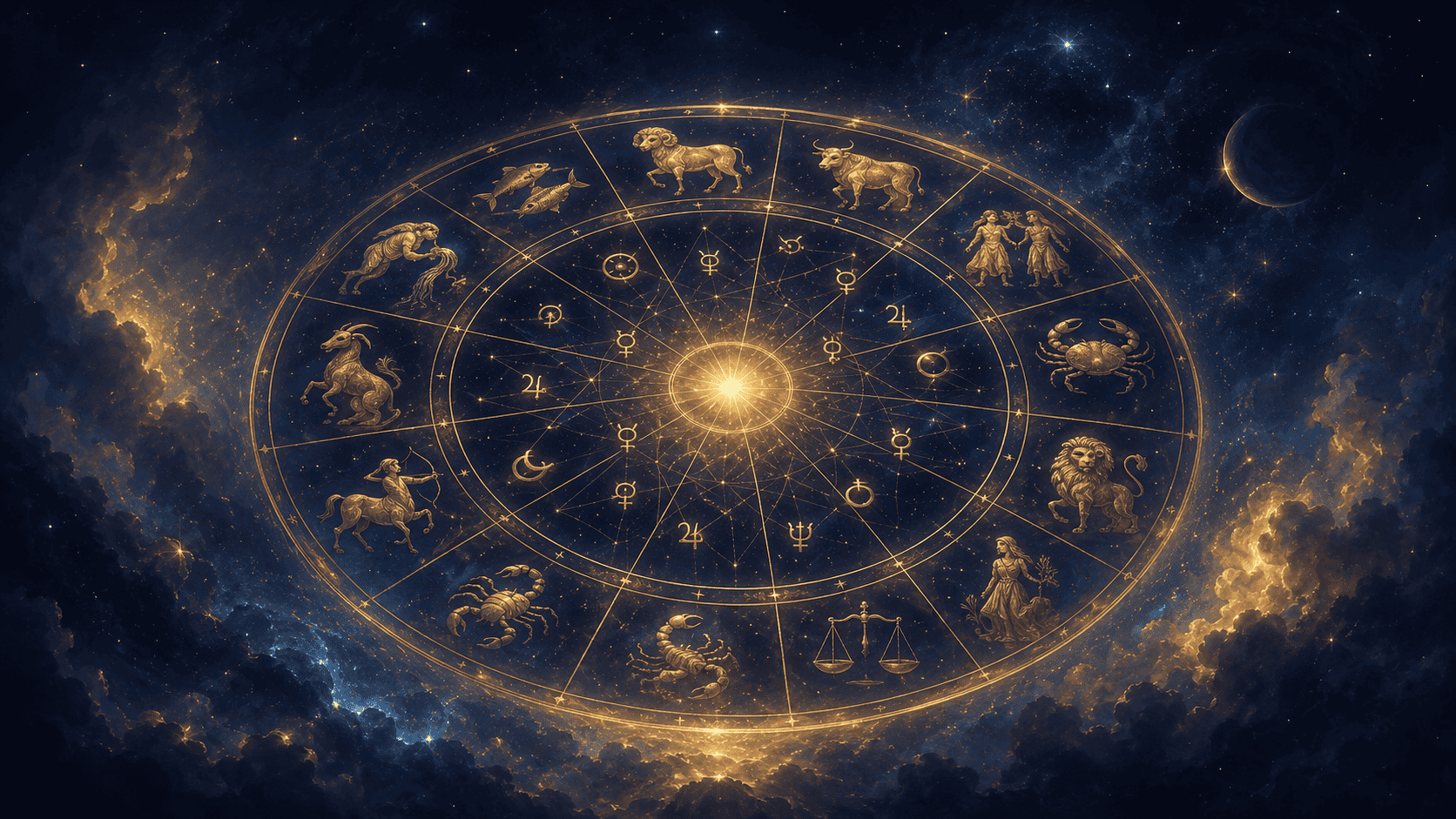
How to read a birth chart starts with understanding what is actually on the page. A natal chart is a snapshot of the sky at the moment of your birth, mapped onto a 360-degree wheel divided into 12 houses. Each planet sits at a specific position. Each position carries meaning. Reading the chart is the practice of integrating those meanings into a coherent picture of personality and timing. Most people stop at their Sun sign and call that astrology. That is like reading the first sentence of a book and reporting on the plot. The Sun sign is the introduction. The chart is the rest of the book.
Learning how to read a birth chart starts with four positions.
Every birth chart has dozens of placements. New readers often try to learn all of them at once and end up paralyzed. The professional shortcut is to master four positions first, in this order, then layer the rest on top once these are fluent. Each position answers a different question about the person. Together they form what experienced astrologers call the foundational read.
Your Sun sign is the question "who am I when I am most myself?" It represents the conscious ego, the part of you that operates when you are at full expression. This is the sign you almost certainly know. It is determined entirely by your birthdate. The Sun sign is the foundation layer of how to read a birth chart, but it is the starting point, not the destination. People who reduce astrology to "I'm a Scorpio" are working at one-fourth the resolution available to them.
Your Rising sign, also called the Ascendant, is the constellation that was rising on the eastern horizon at the exact minute of your birth. It changes every two hours, so you need your birth time to calculate it. The Rising sign represents how you come across to others, your first impression, the mask you wear automatically. Two people with the same Sun sign but different Rising signs can read as completely different people. Rising sign meaning is what makes the Big 3 in astrology actually useful.
Your Moon sign represents your private self, your emotional reflexes, what comforts you, and how you process feelings. The Moon changes signs every 2.5 days, so two people born on the same day can have different Moon signs. Moon sign meaning is the most underrated part of how to read a birth chart. The Moon explains why two people with the same Sun sign can have wildly different inner worlds. If the Sun is who you are at the office, the Moon is who you are at 11pm when you cannot sleep.
Mercury (how you think and communicate), Venus (how you love and relate), and Mars (how you act and pursue) are the personal planets that fill in the next layer of the chart. These can be in different signs from your Sun, which is why someone can be a Sun-Cancer Mercury-Gemini and end up communicating like a butterfly while feeling like a homebody. The interplay between these three planets is where birth chart meaning starts to get specific. The specific integration method that combines all four positions into a single behavioral predisposition map is Redacted, read Chapter 8.
These four positions are sometimes called the Big 3 plus, where "the Big 3" refers to Sun, Moon, and Rising. What are the big 3 in astrology? They are the three positions that, taken together, give you a meaningful read of someone instead of a stereotype. Adding the inner planets gets you to professional resolution.
Why the Big 3 is the answer to most "is astrology bullshit" arguments.
Most skeptics learn that they are a Capricorn, read a Capricorn description, do not recognize themselves in it, and conclude astrology is fake. That conclusion is correct given the data they have. The data they have is one sign out of three. Adding the Moon and Rising signs almost always produces a description that lands. The Big 3 is the minimum viable resolution for how to read a birth chart in any way that means something.
What you identify as. What you want to be known for. The person you describe when someone asks who you are. The Sun is the conscious ego, the curated self, the part that shows up in your bio. It is real but it is not the whole story. The Sun is the only position determined by date alone, which is why it became the basis for newspaper horoscopes. Convenient for entertainment, incomplete for reading a person.
What you actually feel when no one is watching. Moon sign meaning covers your emotional baseline, your reactions, what soothes you, what triggers you, and how you process loss. The Moon is the part of personality that childhood shapes most heavily, the part that runs in the background of every relationship you have. If you have ever wondered why someone can look perfectly fine on paper but feel like a stranger to themselves, the Moon sign is often the missing piece.
How you come across before anyone gets to know you. The Rising sign meaning is about first impressions, body language, the way strangers perceive you in elevators. It is calculated from the constellation rising on the eastern horizon at your exact birth time, which is why birth time accuracy matters for serious chart work. The Rising sign often surprises people more than the Sun because they do not know that this is the layer the world actually sees.
The Big 3 alone resolves most "astrology does not match me" complaints. Run someone's full Big 3 and the recognition is usually immediate. Run only their Sun sign and you are running at one-third resolution. The specific reading order experienced astrologers use to integrate the Big 3, and which one to trust most when they conflict, is Redacted, read Chapter 8.
 View on Amazon
The Master Thyself Book
The full reading method. How professional astrologers actually integrate the chart.
The next layer of how to read a birth chart is the outer planets.
Once the Big 3 plus inner planets are mapped, the next layer of the birth chart is the outer planets: Jupiter, Saturn, Uranus, Neptune, and Pluto. These planets move slowly, so their placements describe generational themes more than personal ones, but their position in your individual chart still matters because they determine which generational themes you metabolize most directly.
Jupiter takes about 12 years to circle the zodiac, so it sits in each sign for roughly one year. Your Jupiter sign indicates where you find growth, optimism, and meaning. It is the planet of philosophy, higher learning, and travel. Jupiter placement also indicates where life seems to deliver opportunity. The shadow side is overextension, hubris, and going too far in the direction Jupiter blesses.
Saturn takes 29.5 years to circle the zodiac. Your Saturn sign indicates where life requires you to learn through restriction, where you carry responsibility, and where maturity is forged through difficulty. Saturn maps closely to the Big Five personality trait of Conscientiousness, which is one of the strongest indicators of life outcomes in modern psychology research. The first Saturn return at age 29 is one of the most documented life-pattern hinges in astrology.
Uranus (innovation, rebellion), Neptune (dreams, dissolution), and Pluto (transformation, depth) move so slowly that everyone born within a few years shares the same sign. Their personal relevance comes from which house they occupy in your chart and what aspects they make to your inner planets. The integration of outer planets into a personal reading is what separates intermediate chart work from beginner Sun-sign analysis. The specific framework for working with outer planet placements is Redacted, read Chapter 8.
Aspects are how the planets talk to each other.
Once you know the position of each planet, the next question is how those planets relate to each other on the chart wheel. Aspects are the specific angular relationships between planets, measured in degrees of the 360-degree wheel. They are what turns a list of positions into a dynamic reading. Most beginner birth chart guides stop before this point. Most professional chart work is mostly aspects.
"A chart without aspects is a list of ingredients. The aspects are the recipe."
Master Thyself, Chapter 8The five major aspects are conjunctions (0 degrees, planets merging), oppositions (180 degrees, tension across a polarity), squares (90 degrees, friction that produces growth), trines (120 degrees, easy flow), and sextiles (60 degrees, supportive opportunity). Knowing the aspects between your Big 3 and inner planets is what produces an accurate read of how your personality actually operates under pressure, in relationships, and over time.
A square between Sun and Moon, for instance, indicates someone whose conscious identity and emotional life are in productive tension. A trine between Venus and Mars indicates someone whose love and action flow together. The combinations and their meanings are what professional astrologers spend years learning. The most important aspect patterns for understanding personality, and the specific integration method that converts an aspect chart into a personal reading, is Redacted, read Chapter 8.
If you have not yet built fluency with the Big 3, working with aspects is premature. Start with Sun-Moon-Rising. Add inner planets. Then add outer planets. Aspects come last, because they require all the previous layers to mean anything. That sequence is how to read a birth chart in the order that actually works.
Your Sun sign is the cover of the book. How to read a birth chart is learning to open the book and read the rest.
Still with us?
Twelve more questions.
Each of these threads is traced to its source in the fuller investigation. If any of them pull, that is the door.
What if ...What if your Sun sign is the least informative position in your chart?
What if knowing your Big 3 (Sun, Moon, Rising) ends 90% of "astrology does not match me" complaints?
What if the Rising sign is what strangers actually perceive, not what you identify as?
What if your Moon sign explains the version of you that emerges at 11pm when you cannot sleep?
What if Mercury, Venus, and Mars fill in the parts of personality the Big 3 leaves blank?
What if Saturn maps directly onto the Big Five trait of Conscientiousness, and modern psychology already validates the correspondence?
What if a chart without aspects is a list of ingredients and the aspects are the recipe?
What if learning how to read a birth chart is the difference between astrology as horoscope and astrology as operating manual?
What if every professional astrologer reads in the same four-position order, and beginners try to skip steps?
What if Carl Jung used birth chart reading in his clinical practice for 30 years, with results he published?
What if birth chart meaning is closer to personality profiling like MBTI and DISC than to fortune-telling?
What if the natal chart is one of the oldest instruments of self-knowledge ever developed?