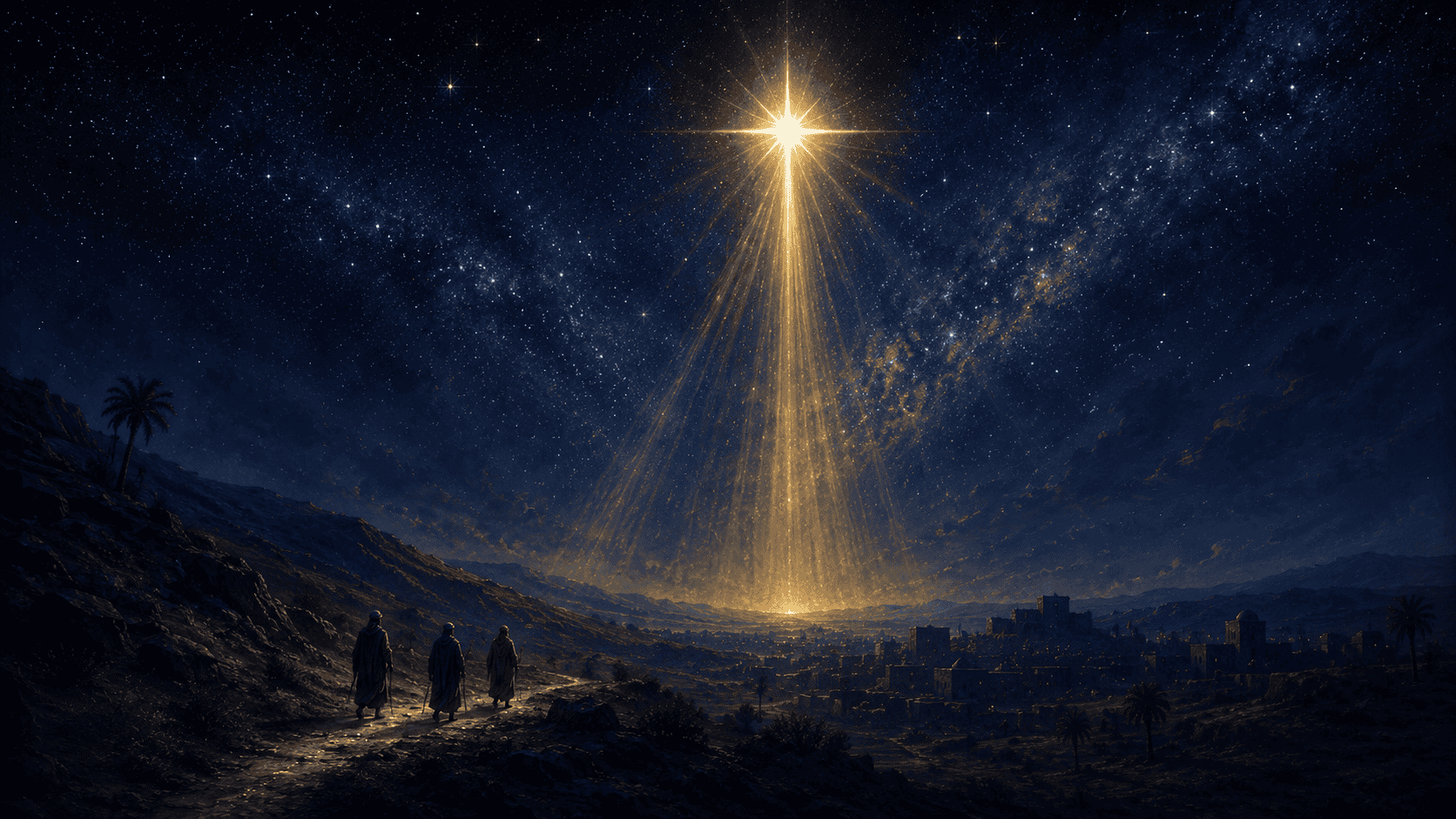
Star of Bethlehem
The Magi were astrologers. The Star was a planetary conjunction. Christianity was founded on the very practice it later condemned.
For 2,000 years, Christianity has celebrated a moment that, read plainly, is an astrological event. Three Persian sky-readers, trained in a priestly tradition that tracked planets for centuries, observed a celestial sign and followed it across hundreds of miles. The Bible calls them magoi. Greek scholarship calls them astrologers. The institution that grew from that moment later condemned the practice that announced its messiah. The Star of Bethlehem is the founding story Christianity tells about itself, and the founding story Christianity will not discuss in those terms.
Who were the magi? Persian astrologers who read the sky for a living.
"Wise Men" is the English Sunday-school translation. The Greek word in Matthew 2:1 is magoi. It does not mean wise. It does not mean kings. It means trained celestial pattern-readers from the Zoroastrian priestly tradition of Persia and Babylon. The Star of Bethlehem story starts with three professional astrologers showing up to find a king they had calculated. That is the literal Gospel account. Centuries of nativity art and Christmas carols have softened the term beyond recognition, but the original word is plain.
The Magi came from Persia and Babylon, home to the longest unbroken astrology tradition in the ancient world. Babylonian sky-readers had been cataloging planetary movements for more than a thousand years before the Star of Bethlehem appeared. By the time of the Nativity, the system was refined, mathematical, and treated as a serious science by every royal court from Egypt to India. The Magi were not desert mystics. They were inheritors of the oldest continuous research program in human history.
Magi were court astrologers, the equivalent of today's senior strategic advisors. They consulted on the timing of military campaigns, royal marriages, founding of cities, and successions. Their entire profession was the reading of celestial timing. When the Star of Bethlehem appeared, they did what they did every working day, applied a centuries-old method to a sky-pattern and produced an interpretation. The interpretation was, a king has been born in Judea, and we are going to verify it.
The Greek magoi is a direct transliteration of the Old Persian magu, the formal title for a Zoroastrian priest-astrologer. The same root gave English the words magic, magistrate, and magus. Pre-Christian connotation was sacred science, not parlor trick. The Church's later association of magoi with magic in the negative sense is a translation drift that conveniently obscures what the original text plainly states. The specific historical moment that drift was engineered is Redacted, read Chapter 9.
Matthew 2:2 records their words exactly. "We have seen his star in the east, and are come to worship him." They saw a star. They interpreted it astrologically. They concluded a king had been born. They traveled hundreds of miles based on that interpretation. The Star of Bethlehem narrative is not about supernatural guidance independent of human discernment. It is about astrologers doing their professional job and arriving at the manger as a direct result.
The Magi did not stumble onto the Nativity. They calculated their way to it. The specific astrological interpretation method they used, why Persian astrology produced this particular reading rather than another, and how the same method applies to your birth chart today, is mapped in Redacted, read Chapter 9.
What was the Star of Bethlehem? A planetary conjunction the Magi read astrologically.
Modern astronomy has identified the most likely candidates for what the Star of Bethlehem actually was. None of them are a supernatural object hanging in the sky for months. All of them are rare planetary alignments that ancient astrologers would have read as enormously significant. The Magi did not see a miracle the way Sunday school describes it. They saw a pattern they had been trained to read.
In 7 BC, Jupiter and Saturn met three times in the constellation Pisces over a single year, a phenomenon that happens roughly once every 800 years for that specific sign placement. Johannes Kepler proposed this as the Star of Bethlehem in 1614. He was both the founder of modern astronomy and a working astrologer, which is exactly the combination needed to make the connection. In Babylonian astrology, Jupiter signified a king, Saturn signified Judea, and Pisces signified the dawn of a new age. The reading was unmistakable to a trained Magi.
On June 17, 2 BC, Jupiter and Venus appeared to merge into a single object so bright it would have been the most striking thing in the night sky. The alignment was visible from Persia and would have appeared low in the eastern sky exactly as Matthew describes. Some astronomers favor this candidate over Kepler's based on Roman census records that align with this date. Astrologically, Jupiter signified blessing and expansion, Venus signified divinity and love. The combined symbol read as a divine king of love arriving in the world.
The exact event matters less than what both candidates have in common. Whichever conjunction the Magi observed, it was a documented astronomical alignment, and it was interpreted astrologically by the people who saw it. They did not perceive a supernatural object. They perceived a pattern in the sky and applied a centuries-refined reading method. The specific decoding logic that converted "two planets meeting in this sign at this time" into "a king is being born in Judea" is what Persian astrologers spent careers mastering, and it is detailed in Redacted, read Chapter 9.
If the Star of Bethlehem was a miracle, it was a miracle that operated through the rules of astrology. The Magi did not get a divine bypass. They got a sky-event that their professional training prepared them to read. The Bible records the event without any apology for the method. Centuries later, the institution founded around that event would condemn the method, and that is where the story gets interesting.
 View on Amazon
The Master Thyself Book
What the Magi knew. What the Church buried.
Three gifts. Three astrological functions.
Gold, frankincense, and myrrh. Sunday school teaches them as expensive presents. The Magi were not bringing baby presents. They were performing a ritual of recognition based on what their astrology told them about the child's life and destiny. Each gift maps to a specific astrological function that the Magi would have determined from the Star of Bethlehem reading. The symbolism is not decorative. It is technical.
Gold has been the symbol of the Sun in nearly every astrological and alchemical tradition on Earth. The Sun in a chart represents identity, sovereignty, and the principle of kingship. By presenting gold first, the Magi were doing what court astrologers did for every newly-crowned monarch in Persia, naming the Sun-aspect of the chart and acknowledging the king-function.
This was the gift that recognized the child as a king, not the gift that made the child into one.
Frankincense was the temple incense of the ancient world, burned in Egyptian, Babylonian, Persian, and Jewish sacred spaces alike. In astrology, Jupiter represents the priest archetype, the function of bridging human and divine. Presenting frankincense was the Magi's astrological declaration that the child carried the Jupiter signature, the priestly function of mediating between heaven and earth.
The specific Jupiter placement in the Magi's reading of the Nativity chart, and what it would have indicated about the child's adult ministry, is Redacted, read Chapter 9.
Myrrh was the embalming oil of the ancient world, used to prepare bodies for burial. Saturn in astrology represents limitation, mortality, the lessons that come through restriction and suffering. By giving myrrh to a newborn, the Magi were performing the most chilling part of the ritual, naming the Saturn-burden the child would carry. They were not bringing a baby gift. They were marking what the chart told them about the death that was coming.
Three planets, three functions, three gifts. The Magi read it and named it. The full Saturn correspondence with the crucifixion narrative is Redacted, read Chapter 9.
Read the three gifts as astrology and the Nativity comes into a focus Sunday school never offered. The Magi were not visiting. They were performing a professional rite of recognition based on a chart they had cast. Gold for the Sun, frankincense for Jupiter, myrrh for Saturn. The technical correspondence is so clean that it argues strongly the Magi were using the same essential framework still taught in classical astrology today.
What the Church did with astrology next.
For the first three centuries after the Nativity, Christianity did not have a unified position on astrology. Early Christian mosaics in churches like Hammat Tiberias and Beit Alpha feature full zodiacs on their floors. Early theologians like Origen accepted that the Star of Bethlehem was an astrological event. The break came later, and when it came it was institutional, not theological. The same Church that celebrated the Magi every year began declaring their profession a heresy.
Early Christians retained substantial astrological interest. Synagogue and church mosaics from the period feature full zodiac wheels. Theologians treated the Magi visit as straightforward historical record, not embarrassing. The Star of Bethlehem was discussed openly as an astronomical and astrological event.
The Council issued canons banning Christian clergy from practicing astrology, divination, or magic. This was the first major institutional move to separate Christianity from the practice that had announced its founder. The Council did not address the contradiction with Matthew 2.
Augustine of Hippo argued against astrology in City of God, framing celestial determinism as incompatible with free will. His position became foundational for later Church doctrine. The argument ignored that astrology, as practiced, has always been probabilistic rather than deterministic, but the conflation served the institutional aim of severing the link to pre-Christian sciences.
Pope Sixtus V issued the bull Coeli et Terrae, formally condemning "judicial astrology" across the Catholic world. The bull was reinforced by Urban VIII in 1631. By this point, the reversal was complete. The Church had spent over a millennium first tolerating, then quietly hostile, then explicitly forbidding the practice that introduced its messiah.
The pattern is the same one repeated across sacred sciences. The institution adopts the founder, then severs the founder's tradition, then condemns the practitioners. Astrology was not erased from Christianity for theological reasons. It was erased for institutional ones. The specific political pressure that drove the Laodicean canons, who benefited from the suppression, and how the same logic was applied to other ancient sciences, is Redacted, read Chapter 11.
Genesis 1:14 sets the foundation.
If astrology is incompatible with the Bible, someone needs to explain Genesis 1:14. The very first chapter of scripture establishes celestial bodies as readable indicators. The Hebrew text uses a word with specific semiotic weight. Translations have softened it, but the original is plain. Astrology's foundational charter is written in the Bible's opening pages.
"And God said, Let there be lights in the firmament of the heaven to divide the day from the night, and let them be for signs, and for seasons, and for days, and years."
Genesis 1:14 (KJV)The Hebrew word translated as "signs" is owth. It does not mean ornament or backdrop. It means a semiotic marker, an omen, an indication that points beyond itself. The same word is used elsewhere in scripture for the rainbow after the flood (a sign of covenant) and for the marks that distinguished Israelite homes during the first Passover (signs that signaled meaning). Genesis 1:14 establishes that the celestial bodies were created precisely to function as indicators that can be read.
That is the entire premise of astrology. The Bible's first chapter installs it. The Magi later acted on it. The Star of Bethlehem narrative confirms it. The Church then spent fifteen hundred years condemning it. The contradiction was institutional, not biblical.
The other biblical passages that affirm celestial reading, including the 12 tribes of Israel mapped to the 12 zodiac signs, the priestly breastplate with its 12 stones, and the specific instructions in Job 38 about ordering the seasons by celestial timing, are Redacted, read Chapter 9. The case is stronger than most pastors will tell you, and it does not require any creative interpretation. It just requires reading what the text actually says.
Christianity celebrates the Magi every December. The institution forgets they were astrologers. The Star of Bethlehem was a calculation, and the calculators were the founders.
Still with us?
Twelve more questions.
Each of these threads is traced to its source in the fuller investigation. If any of them pull, that is the door.
What if ...What if the Star of Bethlehem was the Jupiter-Saturn conjunction Kepler identified in 1614, and Kepler was right?
What if the Magi were professional astrologers and the original Gospel readers knew exactly what magoi meant?
What if gold, frankincense, and myrrh map cleanly to Sun, Jupiter, and Saturn, and the gift order was the chart reading?
What if Genesis 1:14 was the foundational charter for astrology, written in the Bible's opening chapter?
What if the Hebrew word for "signs" in Genesis 1:14 is owth, the same semiotic-marker word used for the Passover blood?
What if Christian mosaics from the first three centuries openly displayed the zodiac wheel in synagogues and churches?
What if the Council of Laodicea banned astrology in 364 AD without ever addressing the contradiction with Matthew 2?
What if Augustine's argument against astrology was based on a misunderstanding of how the system actually works?
What if the 12 tribes of Israel correspond to the 12 zodiac signs in a one-to-one mapping the Church quietly inherited?
What if the three kings of Christmas tradition is a softening of three astrologers, and the institution did the softening on purpose?
What if every pastor reads Matthew 2 every Christmas without ever explaining what magoi actually meant in the original Greek?
What if the Star of Bethlehem was the most public, most celebrated astrological event in human history, and almost no one notices?