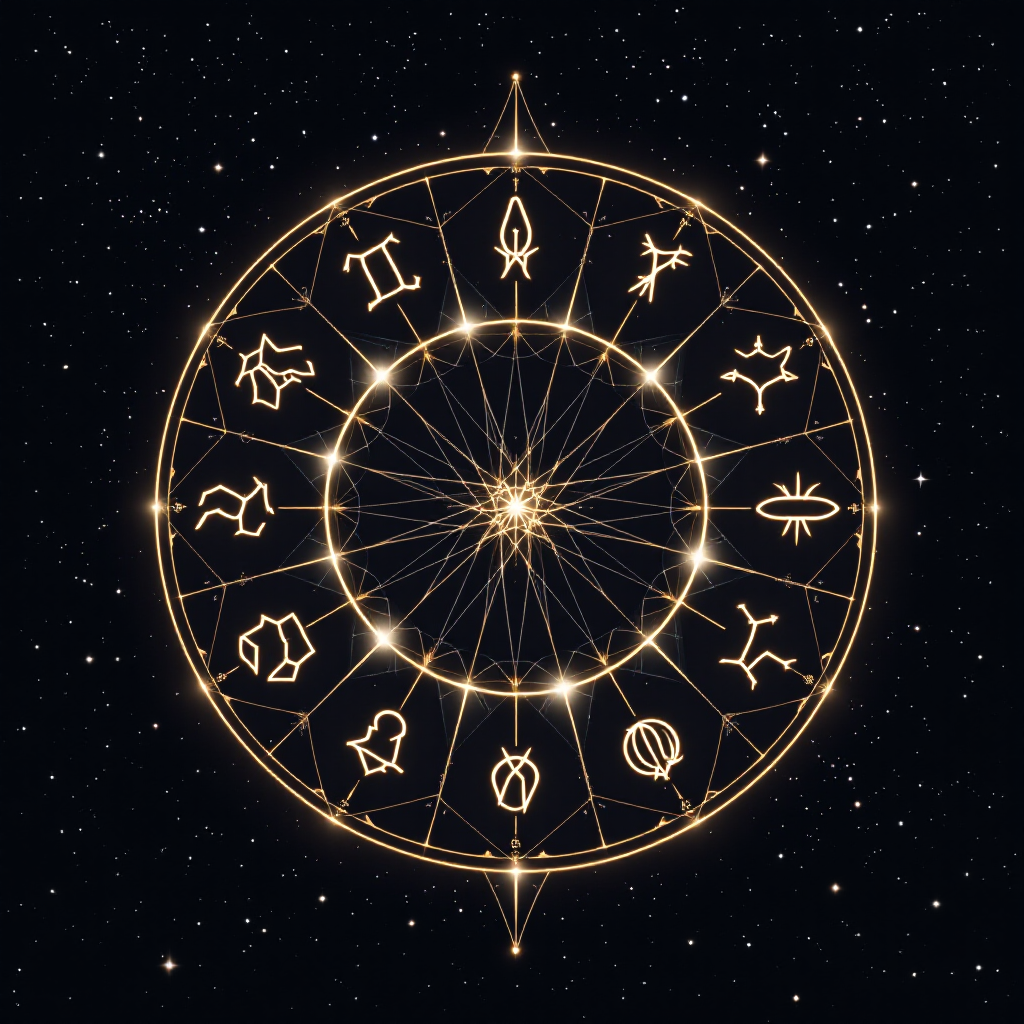
Are there 13 zodiac signs? Every few years this question resurfaces, usually sparked by a viral article claiming NASA discovered a 13th sign called Ophiuchus that changes everything you thought you knew about astrology. The short answer is no, Western astrology has always used 12 signs and continues to do so. The longer answer reveals why the confusion exists, what Ophiuchus actually represents, and how peer reviewed astrology differs fundamentally from astronomy.
The claim about 13 zodiac signs conflates two separate systems. Astronomy tracks physical constellations in space, which are irregular in size and position. Astrology uses a symbolic framework divided into 12 equal segments of 30 degrees each, totaling the 360 degree circle of the ecliptic (the path the sun appears to travel across the sky). These are not the same thing. One measures stars. The other measures cycles, archetypes, and timing.
Understanding this distinction matters because it separates observation from interpretation, structure from symbolism. The zodiac was never meant to be a star map. It was designed as a calendar of consciousness, a twelvefold pattern reflecting divine order and human psychological development.
The Origin of the 13th Sign Controversy
The modern confusion around whether there are 13 zodiac signs began in 2016 when NASA published an educational article explaining the difference between astronomy and astrology. The piece mentioned that Ophiuchus, a constellation the sun passes through between Scorpio and Sagittarius, has been known since ancient times. The Babylonians, who created the zodiac over 3,000 years ago, deliberately left Ophiuchus out because they needed 12 signs to match their 12 month calendar.
NASA was not making a discovery. They were clarifying history. The Babylonians knew about Ophiuchus. They chose not to include it. That choice was intentional, not ignorant. The zodiac was built on the number 12 because that number carried symbolic weight across every ancient culture. Twelve months, twelve tribes, twelve apostles, twelve tones in the chromatic scale. The structure was sacred mathematics, not accidental star counting.
When the NASA article went viral, headlines twisted the message. Suddenly people believed their sun signs had changed, that astrology had been debunked, or that a new sign had been added. None of that was true. Western astrology never claimed to map physical constellations. It uses the tropical zodiac, which is anchored to the seasons and the equinoxes, not to the stars themselves.
Tropical Zodiac vs Sidereal Zodiac
Western astrology operates on the tropical zodiac. This system begins each year at the spring equinox, the moment the sun crosses the celestial equator moving northward. That point is defined as zero degrees Aries, regardless of which constellation sits behind it in space. The tropical zodiac is a time based system, not a star based one. It measures the Earth’s relationship to the sun through the seasons.
The sidereal zodiac, used primarily in Vedic astrology, does track the actual constellations. Over thousands of years, a phenomenon called precession causes the position of the constellations to shift relative to Earth. This is why your tropical sun sign and your sidereal sun sign may differ by nearly a full sign. Neither system is wrong. They measure different things.
Ophiuchus exists as a constellation. It does not exist as a sign in the tropical zodiac because the tropical zodiac was never based on constellations to begin with. Adding Ophiuchus would be like adding a 13th month to the Gregorian calendar because someone noticed an extra moon phase. The framework was not built to accommodate it.
This is not a flaw. It is a feature. The 12 sign structure reflects a complete cycle of archetypal development. Each sign represents a stage of growth, a mode of consciousness, a lesson in the soul’s evolution. Twelve is not arbitrary. It is the number of completion across nearly every spiritual and scientific system humanity has ever built.
Why Twelve Signs, Not Thirteen
The twelvefold pattern appears everywhere in nature, scripture, and sacred architecture. Twelve signs of the zodiac. Twelve months in a year. Twelve tribes of Israel. Twelve apostles surrounding Christ. Twelve cranial nerves in the human head. Twelve musical notes before the octave repeats. The recurrence is not coincidence. It is structure.
In biblical tradition, the number 12 signifies divine order and governance. Revelation describes 12 gates to the New Jerusalem, each inscribed with the name of one of the 12 tribes. Early Christian mystics saw the apostles as a living zodiac, each embodying a distinct archetypal energy circling the solar Christ. This same symbolism was carved into the rose windows of Gothic cathedrals, where the 12 signs appeared alongside the 12 apostles in concentric wheels of glass and light.
If you reduce 12 numerologically, 1 plus 2 equals 3, the number of creation and the Trinity. If you square 12, you get 144, the number of the sealed in Revelation. These are not random math exercises. They are harmonic reflections of the same underlying code. The zodiac is not a collection of stars. It is a map of that code made visible through time.
Ophiuchus, the serpent bearer, does appear in mythology and star lore. Some esoteric traditions associate it with healing, transformation, and the integration of shadow. But integrating it into the zodiac as a 13th sign would require dismantling the entire symbolic architecture that gives astrology its coherence. The system was not designed to be expanded. It was designed to be complete.
What Ophiuchus Represents in Esoteric Tradition
Though Ophiuchus is not a zodiac sign in Western astrology, it carries symbolic weight in other contexts. The constellation depicts a figure holding a serpent, often interpreted as a healer or alchemist mastering the forces of life and death. In Greek mythology, Ophiuchus is linked to Asclepius, the god of medicine who was killed by Zeus for bringing the dead back to life.
Some modern astrologers treat Ophiuchus as a hidden 13th archetype, representing the one who stands outside the cycle, the initiate who has completed the 12 stages and now holds the keys to transformation. This interpretation aligns with the Christ pattern explored in hidden doctrine, where the 13th figure is not part of the circle but the center around which the circle turns.
In Kabbalistic tradition, 13 is the number of unity and transformation. The Hebrew word for love, ahavah, has a numerical value of 13. The word for one, echad, also equals 13. This suggests that 13 does not add to the pattern but transcends it, moving from multiplicity back into oneness. Ophiuchus, in this light, is not a missing sign but a meta sign, the one who integrates all twelve and returns to the source.
However, this remains a symbolic exploration, not a redefinition of the zodiac itself. The tropical system holds at 12 signs because that structure mirrors the solar year, the months, and the archetypal phases of human experience. The complete framework explains how this twelvefold pattern encodes not just personality but timing, resonance, and the alignment of consciousness with cosmic cycles.
The Role of Precession and the Age of Aquarius
Precession is the slow wobble of Earth’s rotational axis, which causes the position of the stars to shift relative to the equinoxes. This cycle takes roughly 26,000 years to complete, moving backward through the zodiac at a rate of about one degree every 72 years. This is why the spring equinox, which once occurred with the sun in the constellation Aries, now occurs with the sun in Pisces, and is moving toward Aquarius.
This shift has no effect on the tropical zodiac. Aries still begins at the spring equinox, by definition. But it does mark the transition between astrological ages, vast epochs lasting approximately 2,100 years each. We are currently moving from the Age of Pisces into the Age of Aquarius, a transition that corresponds with massive cultural, technological, and spiritual shifts.
The Piscean age emphasized faith, institutional religion, and surrender to external authority. The Aquarian age emphasizes transparency, decentralization, and direct access to knowledge. This does not mean the zodiac itself changes. It means the backdrop against which humanity evolves is shifting. The question of whether there are 13 zodiac signs is itself a Piscean confusion, a misunderstanding rooted in the assumption that the map must match the territory.
Astrology is not trying to map the territory. It is offering a lens through which to interpret timing, tendency, and transformation. The stars are markers, not causes. The zodiac is a calendar, not a census. Precession reminds us that even the cosmos is in motion, but the symbolic structure we use to navigate that motion remains stable by design.
Modern Astrology and the Twelve Archetypal Stages
Western astrology treats the 12 signs as a developmental sequence, a journey from birth to mastery. Aries initiates. Taurus stabilizes. Gemini explores. Cancer nurtures. Leo creates. Virgo refines. Libra balances. Scorpio transforms. Sagittarius expands. Capricorn structures. Aquarius innovates. Pisces transcends. Together, they form a complete map of human psychological and spiritual growth.
Each sign is not a box but a frequency, a mode of being that every person expresses to varying degrees depending on their full natal chart. The sun sign is only one piece. The moon, rising sign, and planetary placements create a layered profile that functions much like modern personality assessments such as the Myers Briggs Type Indicator or the Enneagram. The difference is that astrology uses the sky as its reference point rather than a questionnaire.
Adding a 13th sign would not enhance this system. It would fracture it. The twelve archetypes are already sufficient to describe the full spectrum of human experience. Ophiuchus, if included, would either duplicate an existing archetype or introduce a redundancy that weakens the symbolic clarity of the others. The system does not need more signs. It needs deeper understanding of the signs it already has.
This is where the peer reviewed framework becomes essential. Astrology is not superstition. It is pattern recognition, a symbolic language that maps how environmental and cosmic conditions at birth may influence temperament, perception, and psychological predisposition. Research in fields such as biological timing cycles and magnetobiology continues to uncover how subtle forces, including lunar phases and solar activity, affect human physiology and mood.
NASA, Science, and the Zodiac Debate
NASA has repeatedly clarified that they are not in the business of validating or debunking astrology. Their 2016 article was written for children and aimed to explain the difference between astronomy, the scientific study of celestial objects, and astrology, the symbolic interpretation of celestial positions. The article mentioned Ophiuchus to illustrate how constellations and zodiac signs are not the same thing.
Unfortunately, media outlets distorted the message, framing it as NASA proves astrology wrong or NASA adds 13th zodiac sign. Neither claim was accurate. NASA simply reiterated what astrologers have always known: the tropical zodiac is not based on the physical location of constellations. It is based on the Earth’s orbit around the sun and the seasonal markers created by that orbit.
Science and astrology operate in different domains. Science measures physical phenomena. Astrology interprets symbolic relationships. The two are not in conflict unless one is misrepresented as the other. Astrology does not claim to predict specific events with scientific precision. It offers a probabilistic framework for understanding personality, timing, and archetypal influence.
Emerging research into gravitational and magnetic field variations, quantum sensitivity in biological systems, and the effects of environmental conditions on fetal development all point toward mechanisms that could explain why the moment and location of birth might leave a measurable imprint. The stars themselves are not controlling destiny. They are marking conditions, the same way a thermometer marks temperature without causing it.
Why the 13 Sign Myth Persists
The myth persists because it taps into a desire for novelty and disruption. People are drawn to the idea that everything they thought they knew is wrong, that a hidden truth has been revealed. In this case, the hidden truth is not that there are 13 zodiac signs but that most people do not understand what the zodiac actually is.
Astrology has been ridiculed, trivialized, and reduced to newspaper horoscopes for so long that its original depth has been obscured. The zodiac is not entertainment. It is an ancient system of psychological and spiritual mapping, refined over thousands of years by cultures that built calendars, temples, and entire civilizations around celestial observation.
The question are there 13 zodiac signs reveals a confusion between two systems that were never meant to overlap. Astronomy catalogs stars. Astrology organizes time. Both are valid. Neither invalidates the other. The persistence of the myth is itself instructive. It shows how easily symbolic knowledge can be distorted when the underlying structure is not understood.
What the ancients encoded into the twelve signs was not a star chart but a resonance pattern, a map of how consciousness unfolds through cycles of experience. The mechanism behind why this pattern holds, how it interacts with biological development, and the specific protocols for aligning with these cycles rather than resisting them, are detailed in Master Thyself by Alex Wolfram. The public version of astrology has been stripped of its precision. The initiatory version remains intact for those willing to look.
Practical Implications for Your Birth Chart
If you were worried that the addition of a 13th sign changed your sun sign, you can stop worrying. Your birth chart has not changed. The tropical zodiac remains fixed to the equinoxes, and your natal placements are exactly where they have always been. The position of Ophiuchus in the night sky has no bearing on your astrological profile.
However, this controversy does highlight the importance of understanding which zodiac system you are working with. If you consult a Vedic astrologer, your chart will be calculated using the sidereal zodiac, which accounts for precession. Your signs may shift by nearly a full sign compared to your Western tropical chart. This does not mean one system is correct and the other is wrong. They are measuring different things.
The tropical system emphasizes your relationship to the Earth’s seasonal cycle. The sidereal system emphasizes your relationship to the fixed stars. Both offer valuable insights. The key is consistency. Do not mix systems. Choose the framework that resonates with your understanding and work within it.
For most Western astrology practitioners, the twelve sign tropical zodiac remains the foundation. It aligns with the solar year, the agricultural calendar, and the archetypal structure embedded in Western psychological and spiritual traditions. The specific timing windows, lunar phase alignments, and fasting protocols that synchronize with these cycles are calibrated to the tropical system, not the sidereal one. Mixing systems dilutes precision.
The Twelve Signs as a Complete System
The twelve signs form a mandala, a circular map of wholeness. Each sign is a spoke in the wheel, necessary and irreplaceable. Remove one and the structure collapses. Add one and the symmetry breaks. The system is complete because it reflects a universal pattern that repeats at every scale, from the microcosm of the human psyche to the macrocosm of galactic motion.
Aries through Pisces is not a random sequence. It is a developmental arc, a spiral of growth that repeats each year as the sun moves through the signs and each lifetime as the soul moves through incarnations. This is why the question are there 13 zodiac signs misses the point entirely. The zodiac is not a list. It is a cycle. Adding a 13th element does not enhance the cycle. It disrupts it.
In sacred geometry, the number 12 is the number of manifestation and completion. A circle divided into 12 equal parts creates the dodecagon, a shape that has been used in temple construction, religious iconography, and cosmological diagrams across every culture. The twelvefold division is not arbitrary. It is harmonic, resonating with the structure of time, space, and consciousness itself.
What the zodiac offers is not prediction but perspective. It provides a symbolic language for understanding why people respond differently to the same situation, why certain patterns repeat in your life, and how to work with your inherent tendencies rather than against them. The twelve archetypes are enough. They are not limiting. They are liberating, because they reveal the full range of human possibility within a structure that can be learned, practiced, and mastered.
Closing Reflection
Are there 13 zodiac signs? No. Western astrology has always used 12 signs and continues to do so. The confusion arises from conflating astronomy with astrology, constellations with archetypal divisions, and physical star positions with symbolic timing systems. Ophiuchus exists as a constellation. It does not exist as a sign in the tropical zodiac because the zodiac was never built to map constellations. It was built to map cycles.
The twelvefold structure of the zodiac reflects a universal pattern that appears in nature, scripture, and the human body. It is not incomplete. It is exact. The twelve signs form a complete wheel of consciousness, each one a necessary stage in the journey from initiation to transcendence. Adding a 13th sign would not improve the system. It would break it.
Understanding this distinction restores astrology to its original purpose, not as fortune telling but as a framework for self knowledge, timing, and alignment with cosmic rhythm. The stars are not controlling you. They are marking time. The question is whether you know how to read the marks. The map is already complete. What remains is learning how to navigate it.