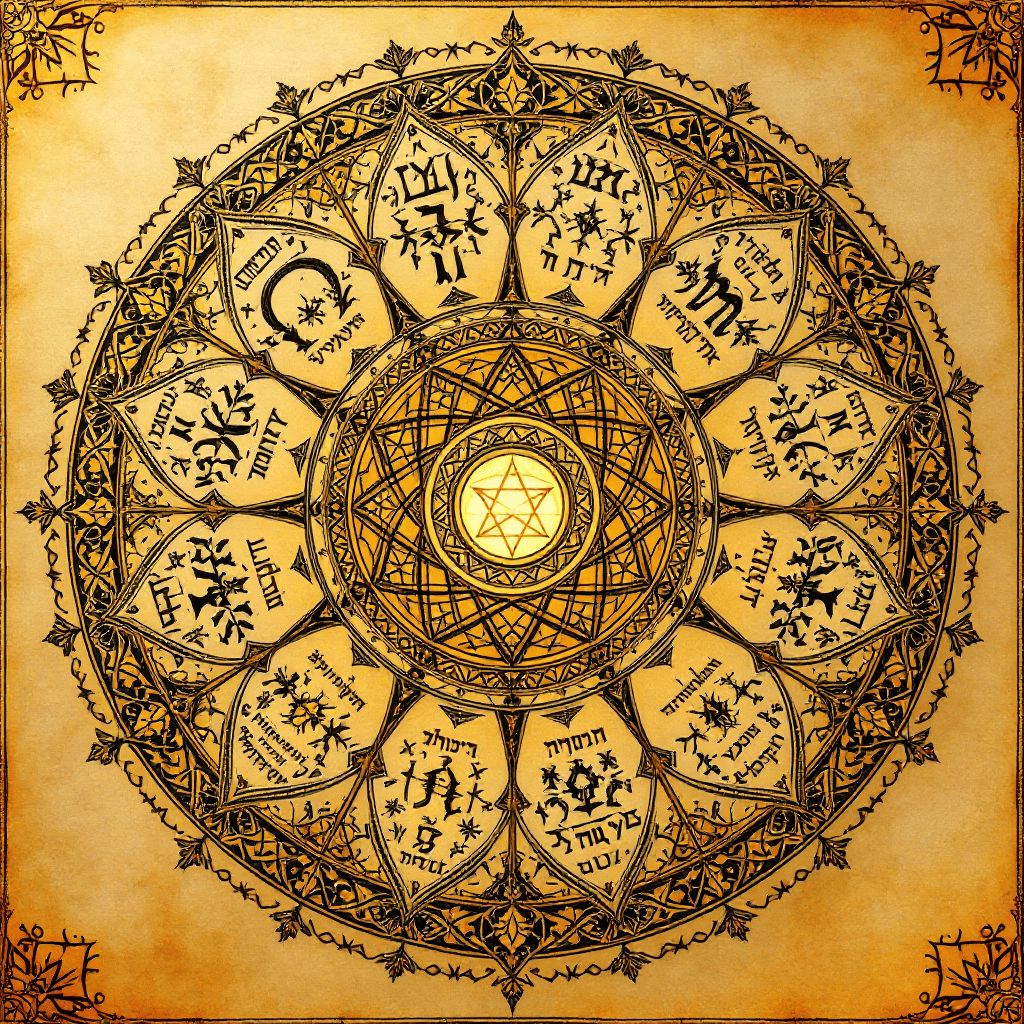
The 12 tribes of Israel and the zodiac share a pattern so precise that it cannot be dismissed as coincidence. Both systems divide sacred structure into twelve archetypal expressions, each carrying distinct qualities, spiritual roles, and symbolic meanings. From Genesis through Revelation, the Bible encodes twelvefold geometry as a signature of divine order, mirroring the same celestial wheel that ancient civilizations tracked across the heavens. The question is not whether the connection exists, but why it was hidden.
Scripture never existed in isolation from the cosmos. The patriarchs, prophets, and temple architects who shaped Israel’s spiritual identity were deeply versed in celestial observation. They built altars aligned with solstices, timed festivals by lunar cycles, and structured worship around sacred astronomy. The twelve tribes of Israel were not merely political divisions. They were living archetypes, each tribe reflecting a distinct facet of divine consciousness, arranged in cosmic order around the Tabernacle like constellations around the pole star.
Understanding this alignment does not require abandoning faith. It requires recognizing that the Bible speaks multiple languages at once: literal, symbolic, numerical, and celestial. The heavens declare the glory of God, and the tribes declare the same order on Earth. As above, so below. This chapter explores how peer reviewed astrology and biblical tradition converge in a single sacred map.
The Twelvefold Pattern in Scripture
Twelve is the Bible’s structural constant. It appears with deliberate repetition across covenants, architecture, and prophecy. The number represents divine government, completeness, and cosmic administration. Every time scripture organizes reality into twelve parts, it signals alignment with celestial order.
The pattern begins with Jacob’s twelve sons, who become the twelve tribes of Israel. It continues through the twelve stones on the High Priest’s breastplate, the twelve loaves of showbread in the temple, and the twelve gates of the New Jerusalem in Revelation. Jesus selects twelve disciples, and Revelation describes twelve stars crowning the woman clothed with the sun. This is not random. This is architecture.
Philo of Alexandria, a first century Jewish philosopher, wrote that the High Priest’s breastplate bearing twelve stones for the twelve tribes mirrored the zodiacal order of the heavens. He saw no contradiction between faith and celestial symbolism. For him, the priest’s garments were a walking cosmos, reflecting the divine structure written in both Torah and sky. The same understanding appears in early Kabbalistic texts like the Sefer Yetzirah, which links the twelve Hebrew letters with the zodiac, the human body, and the months of the year.
The 12 tribes of Israel and the zodiac both function as archetypal maps. Each tribe carries a blessing, a territory, a totem animal, and a spiritual function. Each zodiac sign carries an element, a modality, and a symbolic role in the soul’s evolution. The structure is parallel because the source is the same: divine proportion expressed through sacred twelve.
Jacob’s Blessings as Archetypal Assignments
In Genesis 49, Jacob gathers his twelve sons and delivers prophetic blessings before his death. These are not generic benedictions. Each blessing describes the son’s nature, destiny, and symbolic identity using animal imagery, elemental language, and archetypal traits. The language is poetic, but the structure beneath it is precise.
Judah is called a lion, a solar symbol of kingship and courage. Dan is compared to a serpent, representing wisdom and transformation. Issachar is a strong donkey, symbol of labor and endurance. Naphtali is a deer set free, reflecting swiftness and grace. Benjamin is a ravenous wolf, embodying ferocity and intensity. These are not personality quirks. They are archetypal assignments, roles within a larger cosmic drama.
Early Christian mystics and Jewish Kabbalists both interpreted these tribal identities as reflections of the zodiac. The twelve sons were seen as living constellations, each expressing a unique frequency of divine consciousness. When the tribes camped around the Tabernacle in the wilderness, they formed a mandala, a sacred geometric pattern with God’s presence at the center and the twelve tribes radiating outward like the points of a cosmic clock.
That arrangement was not accidental. It was celestial mimicry, an earthly mirror of the heavenly order. The camp layout in Numbers 2 describes four primary tribal groups positioned at the cardinal directions: Judah to the east, Reuben to the south, Ephraim to the west, and Dan to the north. These four correspond to the fixed signs of the zodiac, the four faces of the cherubim in Ezekiel’s vision, and the four living creatures in Revelation. The structure is consistent across scripture, always pointing back to the same fourfold and twelvefold template.
The Four Fixed Signs and the Camp of Israel
Within the zodiac, four signs are classified as fixed: Taurus, Leo, Scorpio, and Aquarius. These signs anchor the four quadrants of the celestial wheel, representing stability, power, and concentrated energy. In biblical symbolism, these same four archetypes appear repeatedly as the bull, the lion, the eagle, and the man.
Ezekiel describes four living creatures, each with four faces: the face of a lion, the face of an ox, the face of an eagle, and the face of a man. Revelation echoes this imagery with four beasts around the throne of God. Early Church Fathers later assigned these same four symbols to the four Gospel writers: Matthew as the man, Mark as the lion, Luke as the ox, and John as the eagle. The pattern is unbroken. Four fixed points. Four cardinal directions. Four tribal standards around the Tabernacle.
Jewish tradition holds that the tribe of Judah carried a lion standard, Reuben carried a man, Ephraim carried an ox, and Dan carried an eagle. These four tribes led the four camps of Israel in the wilderness. The alignment with the fixed zodiac signs is unmistakable. Judah corresponds to Leo, the lion. Reuben to Aquarius, the man. Ephraim to Taurus, the ox. Dan to Scorpio, the eagle, the elevated form of the scorpion.
This is not interpretation forced onto scripture. This is structure embedded within it. The 12 tribes of Israel and the zodiac mirror each other because they were both designed to reflect the same divine blueprint. One system mapped the heavens. The other mapped the people of God. Both expressed the same sacred geometry.
Mapping the Twelve Tribes to the Zodiac
Various esoteric traditions have proposed correspondences between the twelve tribes and the twelve zodiac signs. These mappings differ slightly across sources, reflecting the symbolic rather than literal nature of the correlation. What remains consistent is the recognition that both systems encode archetypal intelligence through twelvefold structure.
One widely referenced alignment pairs Judah with Leo, reflecting leadership and solar kingship. Reuben, the firstborn who lost his birthright, aligns with Aquarius, the sign of disruption and rebellion. Simeon and Levi, known for their violence, correspond to Gemini, the sign of duality and conflict. Issachar, the tribe of scholars and farmers, mirrors Taurus, the sign of labor and earth. Zebulun, the seafaring tribe, aligns with Pisces, the sign of water and mystery.
Gad, a warrior tribe, corresponds to Aries, the sign of battle and initiation. Asher, blessed with abundance, reflects Libra, the sign of balance and beauty. Naphtali, described as a swift deer, mirrors Sagittarius, the sign of freedom and movement. Benjamin, the ravenous wolf, aligns with Scorpio, the sign of intensity and transformation. Dan, the serpent by the roadside, also corresponds to Scorpio in some interpretations, emphasizing cunning and hidden power.
Joseph receives a double portion through his two sons, Ephraim and Manasseh, who replace him as separate tribes. Ephraim, the younger but greater, corresponds to Taurus, while Manasseh aligns with Cancer, the sign of family and heritage. This substitution maintains the sacred twelve, ensuring the structure remains intact even as the lineage evolves.
These correspondences are not rigid. Different mystical lineages assign tribes to signs in slightly different configurations. The variations do not invalidate the pattern. They confirm it. The point is not to match every tribe to a single sign with absolute certainty, but to recognize that the Bible uses the same twelvefold archetypal language that the zodiac uses. Both systems describe the full spectrum of human and divine expression arranged in cosmic order.
The High Priest’s Breastplate and Cosmic Order
The connection between the 12 tribes of Israel and the zodiac becomes explicit in the design of the High Priest’s breastplate. Described in Exodus 28, the breastplate contained twelve gemstones arranged in four rows of three, each stone representing one of the twelve tribes. The stones were engraved with tribal names and worn over the heart of the priest during sacred rituals.
Philo of Alexandria interpreted this garment as a miniature cosmos. He wrote that the priest, when fully robed, represented the universe itself. The breastplate with its twelve stones mirrored the twelve signs of the zodiac. The ephod and robe reflected the elements and the heavens. The priest did not merely serve in the temple. He embodied the temple, which itself was a scale model of creation.
The twelve stones were specific: sardius, topaz, carbuncle, emerald, sapphire, diamond, jacinth, agate, amethyst, beryl, onyx, and jasper. Ancient and medieval astrologers assigned gemstones to zodiac signs based on color, energy, and symbolic resonance. While exact stone to sign correspondences vary across traditions, the principle remains. The breastplate was not decorative. It was functional, a wearable diagram of celestial and tribal order.
When the priest entered the Holy of Holies, he carried the tribes with him, not just in name but in energetic signature. The stones acted as resonators, anchoring the twelve archetypal frequencies into the ritual space. The priest became the axis mundi, the meeting point of heaven and earth, with the twelve tribes radiating outward like constellations and the divine presence descending from above.
This same twelvefold pattern reappears in Revelation 21, where the New Jerusalem descends from heaven with twelve gates, each named after one of the twelve tribes, and twelve foundation stones, each named after one of the twelve apostles. The city is a cube, a geometric expression of divine perfection, and its structure is organized around the sacred twelve. The zodiac, the tribes, the apostles, and the heavenly city all reflect the same divine proportion. The full synthesis of how these layers interact reveals a cosmology far older than most readers realize.
The Tabernacle as Celestial Map
The arrangement of the twelve tribes around the Tabernacle was not random. Numbers 2 provides precise instructions for where each tribe should camp during the wilderness journey. The layout forms a cross with the Tabernacle at the center, flanked by the Levites who served as priests. The twelve tribes occupy the outer ring, divided into four camps of three tribes each, positioned at the four cardinal directions.
This arrangement mirrors the structure of the zodiac, which is also divided into four quadrants, each containing three signs. The four quadrants correspond to the four elements: fire, earth, air, and water. The four camps of Israel correspond to the four tribal standards: lion, man, ox, and eagle. Both systems describe a sacred wheel with a divine center and twelve expressions radiating outward.
Ancient temple architecture across cultures follows this same template. The Hindu mandala, the Buddhist stupa, the Egyptian temple complex, and the Gothic cathedral all organize sacred space into concentric rings with a holy center. The pattern is universal because it reflects the structure of consciousness itself, a central awareness surrounded by twelve modes of perception and expression.
The 12 tribes of Israel and the zodiac both function as maps of this structure. One describes it in terms of peoplehood and covenant. The other describes it in terms of celestial motion and archetypal energy. The language differs. The geometry is identical. To walk around the Tabernacle was to walk the zodiac. To honor the tribes was to honor the cosmic order they embodied.
Later Jewish mysticism expanded this understanding through the Kabbalistic Tree of Life, which maps ten divine emanations, or sephiroth, onto the structure of reality. Some Kabbalists linked the twelve tribes to the twelve pathways connecting the sephiroth, turning the tribes into energetic channels through which divine light flows into the material world. Others linked them to the twelve permutations of the divine name, the twelve months, and the twelve constellations. The system is fractal. The same pattern repeats at every scale.
Why the Connection Was Hidden
If the alignment between the 12 tribes of Israel and the zodiac is so clear, why is it not taught openly? The answer lies in centuries of theological suppression. Early Church councils worked to separate Christianity from its pagan context, and astrology became a casualty of that effort. The same celestial wisdom that once informed temple design, festival timing, and prophetic vision was reclassified as divination and forbidden.
The process was gradual. In the first few centuries after Christ, many Christians still practiced astrology alongside their faith. Augustine of Hippo initially studied astrology before converting and later condemned it, not for being false but for attributing divine power to the stars rather than to God. The distinction was theological, not astronomical. The problem was not observing the heavens. The problem was worshiping them.
By the medieval period, the Church had consolidated control over scriptural interpretation. Astrology was tolerated in limited contexts, such as medical diagnosis and agricultural planning, but its deeper mystical uses were driven underground. The zodiac imagery remained visible in cathedrals, illuminated manuscripts, and ecclesiastical calendars, but its connection to biblical archetypes was rarely discussed publicly. Those who understood the correlation kept it within esoteric circles.
The Reformation intensified this suppression. Protestants rejected not only Catholic hierarchy but also the symbolic and mystical traditions preserved within it. Astrology was lumped together with alchemy, Hermeticism, and Gnosticism as remnants of pagan corruption. The literal interpretation of scripture became the standard, and allegorical or celestial readings were dismissed as dangerous speculation.
This rupture severed modern Christianity from its own roots. The twelvefold structure encoded in scripture was reinterpreted as merely organizational rather than cosmological. The tribes became historical curiosities rather than living archetypes. The zodiac became horoscopes in newspapers rather than a sacred map of divine order. The inversion was complete. What was once revelation became superstition.
Yet the pattern never disappeared. It was preserved in Kabbalah, in Christian mysticism, in Freemasonry, and in the esoteric schools that maintained the ancient wisdom. Those who knew how to read scripture symbolically could still see the zodiac woven into its structure. The twelve tribes, the twelve apostles, the twelve gates, and the twelve stars all pointed to the same celestial architecture. The code was never lost. It was simply hidden in plain sight, waiting for those with eyes to see.
The Twelve Apostles as Zodiac Archetypes
The same twelvefold pattern that organized the tribes reappears in the New Testament through the twelve apostles. Jesus, the Solar Teacher, stands at the center while his twelve disciples radiate outward, each embodying a distinct archetypal energy. Early Christian mystics interpreted this arrangement as a living zodiac, a human reflection of the celestial wheel.
Different esoteric traditions propose slightly different correspondences, but the structure remains consistent. Peter, bold and impulsive, corresponds to Aries, the initiator. John, the beloved disciple known for emotional depth, aligns with Cancer, the nurturer. Thomas, the skeptic who demanded proof, mirrors Gemini, the sign of duality and intellect. Judas, the revolutionary who betrayed tradition, corresponds to Aquarius, the breaker of old forms.
These are not literal identities. They are symbolic roles within a cosmic drama. The apostles were real historical figures, but their selection and portrayal in scripture also served a deeper purpose. They formed a complete set, a twelvefold mandala around the Christ, ensuring that every archetypal frequency was represented. Just as the twelve tribes camped around the Tabernacle, the twelve apostles gathered around Jesus, making visible the hidden structure of divine consciousness.
Medieval cathedrals made this symbolism explicit. In the great zodiac windows of Chartres and other Gothic churches, the twelve apostles are depicted within a zodiacal wheel, with Christ at the center as the sun. The imagery was not decorative. It was theological, a visual affirmation that the gospel and the cosmos speak the same language. Heaven and earth, scripture and stars, were never separate. They were always one map viewed from two perspectives.
This understanding also appears in the study of sacred anatomy, where the twelve cranial nerves are seen as reflections of the twelve zodiac signs within the human body. The same pattern that organizes the heavens, the tribes, and the apostles also organizes the nervous system. The body is a microcosm of the cosmos, and every level of creation mirrors the same divine proportion. Sacred geometry bridges all of these domains, revealing the mathematical order underlying scripture, anatomy, and the stars.
Reclaiming the Celestial Language of Scripture
The alignment between the 12 tribes of Israel and the zodiac is not speculation. It is encoded structure, visible to anyone willing to read scripture as a layered text. The tribes were not merely political units. They were archetypal expressions of divine order, arranged in cosmic formation around the presence of God. The zodiac is not fortune telling. It is a symbolic map of the same order, tracking the movement of archetypal energy through time and space.
Both systems describe the full spectrum of consciousness. Both organize reality into twelve archetypal modes. Both reflect the same mathematical proportion that governs creation at every scale. The pattern is fractal, repeating in the stars, in scripture, in the human body, and in the architecture of sacred space. To recognize this is not to abandon faith. It is to recover the original language through which faith was expressed.
The Bible never forbade celestial observation. It forbade idolatry, the worship of creation rather than the Creator. But Genesis 1:14 explicitly states that the lights in the heavens were placed for signs and seasons. The heavens were meant to be read. The question is whether we have been taught to read them correctly. For most of Christian history, that knowledge was suppressed, not because it was false but because it was powerful. A population that can read the stars and interpret the cycles of creation is harder to control than one that depends entirely on external authority.
Reclaiming this knowledge does not require rejecting scripture. It requires reading scripture the way its original authors intended, as a multilayered transmission operating simultaneously on literal, moral, allegorical, and mystical levels. The tribes were real. They were also symbols. The zodiac is real celestial motion. It is also a symbolic language. Both are true. Both operate at once. The conflict was manufactured by institutions that preferred a population dependent on mediation rather than direct discernment.
Today, the tools are available. The texts that were hidden have been recovered. The manuscripts that were suppressed have been translated. The geometry that was encoded in cathedrals and temples is now understood. The question is whether you will use those tools or continue accepting the sanitized version designed to keep you passive. The 12 tribes of Israel and the zodiac were always the same map. One pointed to heaven. One pointed to earth. Both pointed to you.
Closing Reflection
The twelve tribes were never just history. They were prophecy, geometry, and consciousness made visible. Each tribe carried a frequency, a role, a piece of the whole. Together they formed a living zodiac, a map of divine order written into flesh and covenant. The pattern did not end with ancient Israel. It continued through the apostles, the gates of the New Jerusalem, and the structure of the cosmos itself. Twelve is not a number. It is a code.
Understanding the 12 tribes of Israel and the zodiac as parallel systems does not diminish scripture. It deepens it. The Bible was written by people who knew how to read the heavens, who understood sacred proportion, and who encoded multiple layers of meaning into a single text. Modern readers were taught to see only the surface. Those who learn to see the structure beneath it gain access to a wisdom that has been available all along, hidden in plain sight, waiting for recognition.
The question is not whether the pattern exists. The evidence is overwhelming. The question is what you do with it once you see it. Do you dismiss it because it challenges comfortable narratives, or do you integrate it and allow your understanding of scripture, cosmos, and self to expand? The pattern was never lost. It was always there, encoded in the stars, preserved in the tribes, and reflected in the structure of your own being. Now you know where to look.