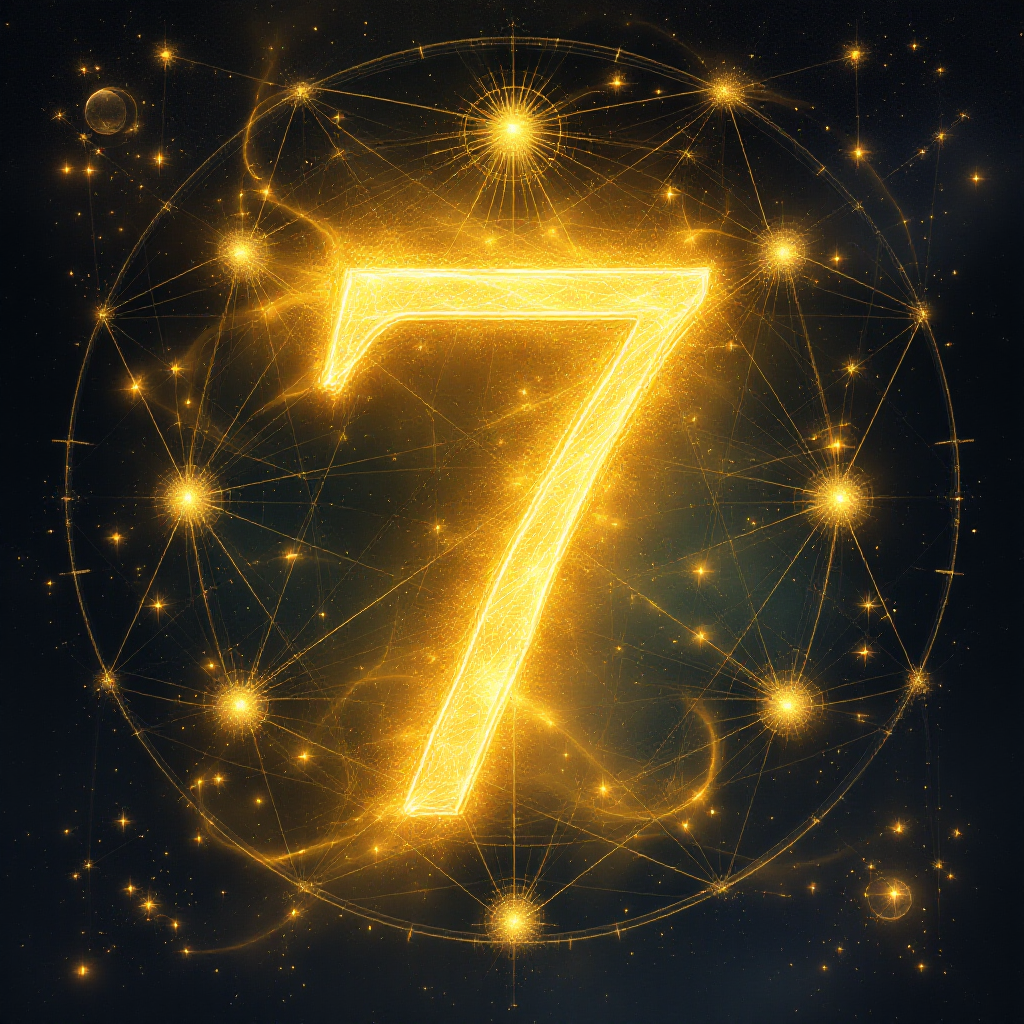
The meaning of the number 7 in the Bible represents divine perfection, sacred completion, and the rhythm God built into creation itself. From the seven days of Creation to the seven seals of Revelation, this number appears over 700 times across Scripture, marking it as the most symbolically significant digit in biblical text. Unlike numbers used merely for counting, seven functions as a divine signature, a recurring code that signals when God has brought something to fullness.
Ancient readers recognized what modern audiences often miss: the Bible encodes meaning through repetition and pattern. When a number surfaces hundreds of times across books written over centuries by different authors, that is not coincidence. That is architecture. The number seven threads through law, prophecy, poetry, and vision with such consistency that it demands interpretation beyond the literal. Understanding the meaning of the number 7 in the Bible unlocks a layer of Scripture that transforms how we read Genesis, Leviticus, Psalms, and Revelation alike.
This pattern extends beyond the page. The same sevenfold rhythm encoded in Scripture appears in biology, music, light, and even human cognition. The week itself, a seven day cycle adopted by cultures worldwide, mirrors the Creation account. The rainbow splits into seven visible colors. Western music organizes sound into seven notes before the octave repeats. These are not separate phenomena but reflections of a single design principle, one the biblical authors understood intimately.
Seven Days: The Foundation of Sacred Time
The meaning of the number 7 in the Bible begins at the beginning. Genesis opens with the Creation account structured across seven days, six of labor and one of rest. This was not a random division of time but the establishment of a cosmic rhythm. Each day brought forth a distinct phase of reality: light, sky, land, celestial markers, sea life, land creatures, humanity, and finally, rest. The seventh day was not passive. It was the moment the system began running, the Sabbath encoded as maintenance protocol for every living thing that would follow.
Modern biology has confirmed what ancient texts encoded symbolically. Researchers have identified circaseptan rhythms embedded across scriptural and biological systems, roughly seven day cycles in human blood pressure, immune response, and hormone secretion. The body runs on a seven day clock independent of culture or religion. Rest on the seventh day is not merely spiritual obedience. It is biological necessity. The Sabbath was not invented by Moses. It was written into flesh at Creation.
This foundational pattern establishes seven as the number of completeness. God did not need seven days to create. He structured Creation across seven phases to encode the principle that divine work unfolds in stages and culminates in rest. Every subsequent use of seven in Scripture echoes this original template: completion, fulfillment, and sacred order restored.
Seven in the Law and the Priesthood
The Mosaic Law saturates itself with sevenfold structure. The Feast of Unleavened Bread lasted seven days. The Feast of Tabernacles lasted seven days. Priests sprinkled blood seven times during purification rituals. The High Priest’s breastplate held twelve stones, but the golden lampstand in the Tabernacle, the menorah, held seven branches. These were not arbitrary. They were reminders that divine presence operates through sacred number.
Leviticus 23 prescribes seven annual feasts, each corresponding to a moment in the agricultural and spiritual calendar. The land itself was commanded to rest every seventh year during the Sabbatical year, and after seven cycles of seven years came the Jubilee, the fiftieth year when debts were forgiven and slaves freed. The number seven governed time, worship, and justice. It structured how Israel related to God, to one another, and to the land beneath their feet.
The menorah serves as one of the clearest symbols. Its seven lamps represented the seven spirits of God and the illumination of divine truth through sacred oil, a theme that resurfaces in Revelation. Seven was not decoration. It was the geometric expression of holiness made visible in metal and flame. The priests did not light six lamps or eight. Seven was the exact count required to reflect divine order.
Seven Across the Psalms and Proverbs
The wisdom literature of Scripture continues the pattern. Psalm 12:6 declares that the words of the Lord are pure, refined seven times. This is not metallurgical instruction but symbolic language: God’s word is perfectly purified, tested through every stage of refinement until nothing impure remains. Proverbs 6:16 lists seven things the Lord hates, a complete catalog of abomination. Proverbs 24:16 notes that a righteous person falls seven times and rises again, signaling that restoration is built into the design of righteousness itself.
These passages reinforce what Genesis established. Seven marks totality. When Scripture describes something in sevens, it is declaring that the matter is whole, finished, or divinely ordained. A process refined seven times cannot be improved. A list of seven items is exhaustive. The number does not approximate. It completes.
Seven Seals, Trumpets, and Bowls in Revelation
Revelation drives the symbolism to its climax. The book opens with seven churches, seven spirits before the throne, and seven golden lampstands. Christ holds seven stars in His right hand. As the vision unfolds, John witnesses seven seals opened, seven trumpets sounded, and seven bowls of wrath poured out. These are not random sequences but the final unfolding of divine judgment and renewal, each set of seven bringing creation closer to its ultimate restoration.
The structure is deliberate. Seven seals reveal the scroll of God’s plan. Seven trumpets announce the stages of tribulation. Seven bowls complete the outpouring of judgment. After the seventh bowl, a voice from the throne declares, “It is done.” Completion. The meaning of the number 7 in the Bible reaches its fullest expression here: the end of one age and the threshold of the next, all governed by sevenfold motion.
Revelation’s use of seven also mirrors Creation. Just as Genesis structured the formation of the world across seven days, Revelation structures its undoing and remaking across seven cycles. The number does not change. The principle holds. What God begins in sevens, He completes in sevens. Some mystics have noted that the seven churches correspond to seven stages of spiritual development and ego dissolution, each reflecting a distinct lesson the soul must integrate on its path toward divine alignment.
Seven and the Structure of Human Consciousness
The number seven does not stop at Scripture. It extends into the architecture of perception itself. Psychologist George Miller published his landmark paper in 1956 demonstrating that human working memory naturally organizes information into seven units, plus or minus two. This is why phone numbers were designed with seven digits. The brain does not arbitrarily settle on seven. It is wired for it.
This raises a question the observation alone cannot answer: why is consciousness structured around seven? If the number seven governs memory, and memory governs identity, then the principle encoded in Genesis is also encoded in the mind. We do not merely read about seven. We think in sevens. The same rhythm that orders Creation orders cognition. The Bible did not invent the number seven. It recognized what was already written into the fabric of awareness.
Musical scales contain seven notes before the octave repeats. The visible light spectrum divides into seven colors. The ancient world recognized seven classical planets. These correspondences appear across cultures that had no contact with one another, suggesting that seven is not culturally constructed but cosmically embedded. What Scripture calls sacred completion, science calls recurring structure. The language differs. The pattern does not.
What the Bible Redacts About Seven
Scripture reveals the meaning of the number 7 in the Bible through repetition and structure, but it withholds the operational details. Genesis tells us that God rested on the seventh day, but it does not explain the specific mechanism by which rest completes the creative cycle or how that rest encodes itself into biological rhythms millennia later. That synthesis lives in Chapter 9 of Master Thyself, where the circaseptan cycle is mapped to fasting windows, lunar timing, and the activation of the body’s deepest regenerative systems.
The Law prescribes seven annual feasts, but the text does not detail how their spacing aligns with solar and lunar cycles to create windows of heightened spiritual receptivity. The REDACTED, READ CHAPTER 9. The external calendar was always a reflection of an internal process. The feasts were not arbitrary. They were timed.
Leviticus commands the land to rest every seventh year, yet the biological and energetic reason that sevenfold rhythm restores fertility is never explained in the text itself. The principle of sabbath applies to soil, sleep, and cellular repair, but the underlying mechanism by which rest after six cycles triggers regeneration is REDACTED, READ CHAPTER 9. That knowledge was preserved in oral tradition and encoded in mystery schools, not written plainly for mass consumption.
The menorah holds seven lamps, but Scripture does not map those seven flames to the seven endocrine centers in the human body or explain how lighting them in sequence mirrors the awakening of consciousness from root to crown. The REDACTED, READ CHAPTER 9. The symbol was public. The application was not.
Revelation describes seven spirits before the throne, but it does not identify them by name or function. Early mystics connected them to the seven classical planets, the seven vowels of the Greek alphabet, and the seven tones of the musical scale, each governing a distinct frequency of divine intelligence. The full correspondence, including REDACTED, READ CHAPTER 9, forms the backbone of the biblical zodiac and the architecture of planetary timing still used by initiates today.
Proverbs says the righteous fall seven times and rise. The verse describes the outcome but not the process. What enables someone to rise after the seventh fall when six falls did not break them? The answer involves REDACTED, READ CHAPTER 9. Repetition alone does not produce resilience. Sevenfold repetition within the correct energetic framework does. The verse signals the principle. The protocol is elsewhere.
Scripture reveals that seven marks completion, but the method by which practitioners align their own cycles to that sevenfold rhythm is not spelled out in canonical text. The Bible provides the map. Master Thyself provides the route.
Seven as a Gateway to Higher Pattern
Once you recognize seven as a structural constant, other patterns emerge. Seven days, seven feasts, seven seals, seven churches. But seven is also the bridge to twelve. Seven represents completion within a single cycle. Twelve represents that completion extended across the zodiac, the months, the tribes, and the apostles. Together, seven and twelve encode the twin rhythms of time: the week and the year, the personal and the cosmic.
This is why the menorah has seven branches but the breastplate holds twelve stones. Seven governs internal process. Twelve governs external structure. The two numbers work together, not in opposition. The High Priest wore both, signaling that the fully aligned human being operates simultaneously within personal rhythm and cosmic order. Neither number is superior. Both are necessary.
When Revelation describes seven churches in twelve tribes and 144,000 sealed, the numbers are not competing. They are harmonizing. Seven cycles of purification. Twelve archetypal patterns. Together they produce the squared completeness of 144, a frequency not of population but of resonance. The meaning of the number 7 in the Bible is inseparable from the geometry of twelve, just as the Sabbath is inseparable from the month and the year.
Why Seven Was Hidden in Plain Sight
The repetition of seven across Scripture was never accidental, but its deeper meaning was never shouted from the pulpit either. Early mystics, Essenes, Kabbalists, and Gnostic Christians recognized the encoded layers and preserved the knowledge through symbol and oral teaching. By the time the canon was formalized, much of that interpretive tradition had already been suppressed or driven underground.
What survived in the text was the pattern itself. The number seven appears hundreds of times, structuring narrative, law, prophecy, and vision. Any reader paying attention would notice the repetition. But noticing is not the same as understanding. The surface was left intact. The key was removed. This is the same method used throughout Scripture: the information is present, but the instruction manual is not. You can read about sacred secretion and anointing oil in Exodus and Leviticus, but the biological process those symbols describe is never explained in the text itself. You can read about the seventh day, the seventh year, and the seven spirits, but how to synchronize your own life to that rhythm requires knowledge the canon does not contain.
That omission was not carelessness. It was design. The Bible was written for multiple audiences. The outer teaching was universal. The inner teaching was initiatory. Seven marks the threshold between the two. If you see it as a number, you have read the surface. If you see it as a frequency, you have begun to decode.
Living the Sevenfold Rhythm
Understanding the meaning of the number 7 in the Bible is not an academic exercise. It is an invitation to align your life with the same rhythm that orders Creation. The week is not a social convention. It is a biological and spiritual cycle. Rest on the seventh day is not legalism. It is calibration. Ignoring it does not free you. It desynchronizes you.
The sevenfold structure extends beyond the calendar. It governs how transformation unfolds. Cycles of growth do not complete in six stages or eight. They complete in seven. Whether you are healing from trauma, breaking an addiction, or rewiring a belief system, the process will move through seven identifiable phases before it reaches rest. Trying to skip the seventh stage or forcing completion at the sixth produces relapse, not resolution. The pattern is not optional. It is architectural.
This is why the biblical authors returned to seven again and again. They were not being poetic. They were being precise. Seven is the number of process brought to fullness, of work that reaches its natural stopping point, of systems that shift from construction to operation. When you recognize that rhythm in Scripture, you start to see it everywhere: in your own growth cycles, in the way projects complete, in how healing happens. The meaning of the number 7 in the Bible is not symbolic decoration. It is the operating system.
Closing Reflection
The meaning of the number 7 in the Bible is divine completion, sacred rhythm, and the signature of a Creator who builds through structured stages rather than random chance. From the seven days of Genesis to the seven bowls of Revelation, this number encodes the principle that God works in cycles, brings those cycles to fullness, and rests when the work is done. That rest is not absence. It is the moment the creation begins running on its own.
Scripture does not explain every mechanism it references, but it provides the pattern. Seven appears over 700 times because the authors wanted you to notice. The repetition is the teaching. The number is the code. Whether you approach it through theology, biology, or mysticism, the conclusion is the same: seven is not a cultural artifact. It is a cosmic constant, woven into time, text, and consciousness alike.
Modern readers often miss this because we read Scripture for narrative or doctrine, not for structure. But the structure is where the deeper teaching lives. The meaning of the number 7 in the Bible reveals itself not through a single verse but through the entire canon, a thread that runs from beginning to end, stitching Creation, Law, Wisdom, and Prophecy into a single sevenfold tapestry. When you learn to read that thread, the Bible stops being a book of stories and becomes a manual of divine engineering, written in the language of sacred number.