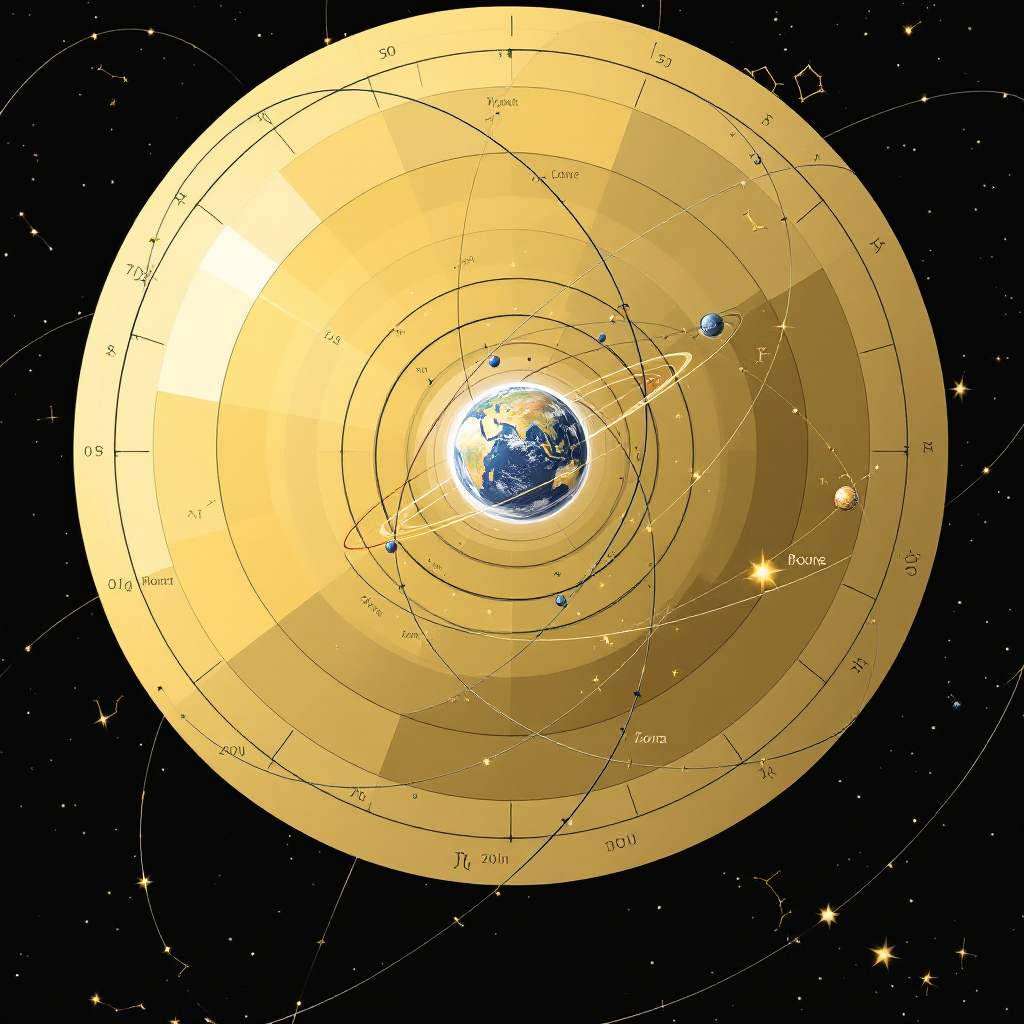
Precession of the equinoxes explained begins with a simple fact: Earth wobbles. The planet spins on an axis that is not fixed but slowly circles like a spinning top winding down. This wobble takes roughly 26,000 years to complete one full cycle. During that time, the position of the spring equinox shifts backward through all twelve zodiac constellations. Ancient astronomers noticed this drift and called it precession. Modern science confirms it. The precession of the equinoxes is the astronomical engine behind the concept of astrological ages, the reason why humanity moves from one age to another across millennia.
Most people learn that the equinoxes mark the two moments each year when day and night are roughly equal in length. Spring equinox arrives around March 20. Fall equinox comes around September 22. What most people do not learn is that the backdrop of stars behind those equinoxes changes over time. The sun rises against a different constellation every 2,160 years or so. That shift is precession. It is slow, steady, and measurable. It was known to the ancients, forgotten by many, and rediscovered repeatedly across cultures.
The Mechanics Behind Precession
Earth’s axis tilts at about 23.5 degrees relative to its orbit around the sun. That tilt gives us seasons. But the axis does not stay pointed in one direction forever. Gravitational forces from the sun and moon pull on Earth’s equatorial bulge, causing the axis to trace a slow circle in space. This motion is called axial precession. One complete circle takes approximately 25,772 years, though the number is often rounded to 26,000 for simplicity.
As the axis shifts, so does the point in the sky where it appears to aim. Right now, Earth’s north pole points roughly toward Polaris, the North Star. In about 13,000 years, it will point toward Vega instead. This rotational drift also means that the position of the spring equinox, the moment the sun crosses the celestial equator moving northward, shifts backward through the zodiac constellations at a rate of about one degree every 72 years. The result is a grand cycle that ancient cultures tracked with precision and encoded into myth, monument, and calendrical systems rooted in celestial observation.
Greek astronomer Hipparchus is credited with discovering precession around 130 BC, though evidence suggests earlier civilizations already knew. The Egyptians aligned temples to stars that no longer occupy the same positions. The Mayans built observatories that tracked cycles longer than any single human lifetime. The Vedic texts of India reference yugas, vast epochs of time that mirror precessional rhythm. These were not primitive guesses. They were sophisticated astronomical records passed down through generations.
Why Ancient Cultures Tracked Precession
Precession was not academic trivia to the ancients. It was sacred knowledge. Civilizations rose and fell within a single age. Kingdoms that dominated one constellation’s era became dust before the next. To track precession was to read the mind of time itself, to know where humanity stood within the great turning of the cosmic wheel.
The Egyptians oriented the Great Pyramid to true north with a precision modern engineers struggle to replicate. Some researchers argue the Sphinx originally faced Leo during the Age of Leo, roughly 10,000 BC, a claim based on water erosion patterns and astronomical alignment. Whether that timeline holds or not, the intent is clear: the ancients built monuments as clocks, markers in stone that would outlast language and empire.
The Precession of the Equinoxes divides the great cycle into twelve astrological ages, each lasting approximately 2,160 years. Humanity is currently in the transition between the Age of Pisces and the Age of Aquarius. Pisces, symbolized by the fish, aligns with the rise of Christianity and themes of faith, sacrifice, and institutional religion. Aquarius, symbolized by the water bearer, corresponds to transparency, decentralization, and the distribution of knowledge. The shift is not instant. Ages overlap. Themes bleed into one another. But the direction is unmistakable.
In Chapter 8 of Master Thyself, the concept of astrological ages tied to precession is explored in depth. The transition from Taurus to Aries marked the shift from prosperity worship to covenant and law. Moses destroying the Golden Calf was not random. The calf represented Taurus, the age that had ended. The ram, symbol of Aries, became the new sacrificial animal. When Jesus emerged at the start of Pisces, his followers were fishermen. The ichthys, the fish symbol, became the mark of early Christians. The pattern repeats. Each age carries its own symbolic language, and the precession of the equinoxes explained is the mechanism that turns the page.
Precession and the Great Year
The full precessional cycle of roughly 26,000 years is called the Great Year. Ancient philosophers, particularly the Platonists and Stoics, spoke of this cycle as a cosmic inhale and exhale, a rhythm in which civilizations rise, peak, collapse, and are reborn. Plato wrote of a time when the cosmos reverses its motion, a poetic description some interpret as allegory for precession.
The Great Year was not just philosophy. It was astronomy rendered as theology. The ancient world encoded this knowledge into myth and monument, passing it forward through symbol because numbers alone could not survive the collapse of empires. The zodiac became a library. Each constellation held a chapter. Precession turned the pages.
Modern science treats precession as a curiosity, a footnote in astronomy textbooks. Ancient cultures treated it as scripture. They timed rituals, built temples, and structured governance around celestial rhythm. The heavens were not distant. They were the operating system. Precession was the clock that told them when the code would shift.
The Astrological Ages and Human Consciousness
Each astrological age corresponds to a dominant mode of human consciousness. These are not rigid boundaries but environmental conditions, like seasons. The qualities of each age shape the collective focus of civilizations within it.
The Age of Taurus, roughly 4000 to 2000 BC, emphasized material wealth, agriculture, and fertility. Bull worship dominated Egypt, Mesopotamia, and Crete. Prosperity was divine. The earth was goddess. Stability was the goal.
The Age of Aries, roughly 2000 BC to 1 AD, brought law, sacrifice, and structure. Moses received the commandments. The ram became the symbol of covenant. Authority centralized. Discipline replaced abundance as the highest virtue.
The Age of Pisces, roughly 1 AD to 2100 AD, introduced faith, compassion, and surrender. Jesus was the fisher of men. Christianity spread through the symbol of the fish. Belief became the bridge to salvation. Institutional religion mediated the divine.
The Age of Aquarius, beginning now, signals transparency, knowledge distribution, and collective responsibility. The water bearer pours out what was once held by priests and kings. Information flows freely. Hierarchies flatten. The question is no longer what you believe but what you know. The full framework of how these ages operate and what comes next requires understanding not just the astronomy but the energetic architecture beneath it.
This is where precession becomes more than mechanics. It becomes map. If each age represents a shift in collective focus, then the transition points between ages represent crises of identity. Humanity clings to the old symbols even as the new age begins. The fish on the bumper sticker is the modern equivalent of the Golden Calf. Not wrong, just anchored to a cycle that is closing.
How Precession Was Measured Without Telescopes
The ancients had no telescopes, no computers, no satellites. What they had was time, patience, and multi-generational observation. They tracked the heliacal rising of stars, the first appearance of a star on the eastern horizon just before dawn. Over decades, they noticed the drift. A star that rose with the sun in one generation rose slightly earlier in the next. The shift was small, one degree every 72 years, but it was consistent.
Stone circles, pyramids, and temples were not merely religious structures. They were observatories. Alignments were deliberate. Doorways framed specific stars on specific dates. When those alignments drifted, the priests knew. Precession was not theory. It was measured fact, encoded in architecture that would survive long after the astronomers who built it were gone.
The Dendera Zodiac, a ceiling carving from Egypt’s Temple of Hathor, displays the twelve zodiac signs and the precession-aware positioning of constellations. The Antikythera Mechanism, a Greek analog computer from around 100 BC, calculated astronomical cycles including precession. These were not outliers. They were the norm. Advanced cultures tracked the sky as carefully as modern meteorologists track storm systems.
When the Library of Alexandria burned, when Rome fell, when the Dark Ages descended, much of this knowledge was lost. But not all. Secret societies, mystical orders, and cathedral builders preserved fragments. The Gothic cathedracts of Europe embedded zodiac wheels in stained glass. The Masons encoded geometry into their rites. The continuity was underground, but it never fully broke.
Precession in Sacred Texts
Biblical scripture contains references to precession, though they are symbolic rather than explicit. Genesis 1:14 states that the lights in the heavens were made for signs and seasons. The Mazzaroth, mentioned in Job 38:32, is widely interpreted as the zodiac or the cycle of constellations. Psalm 19:1 declares that the heavens proclaim the glory of God, suggesting that celestial motion carries divine message.
Revelation 12:1 describes a woman clothed with the sun, the moon under her feet, and a crown of twelve stars. Many scholars see this as a reference to the constellation Virgo during a specific precessional alignment. The twelve tribes of Israel, the twelve apostles, and the twelve gates of the New Jerusalem all mirror the twelve signs of the zodiac. This is not coincidence. It is cosmological architecture rendered as theology.
The ancient Hebrews, Egyptians, Babylonians, and Greeks all understood that the heavens moved in cycles longer than empires. They wove that understanding into myth, law, and prophecy. The precession of the equinoxes was the clock. The stories were how they taught people to read it.
Modern Science and the Rediscovery of Precession
Today, precession is taught in astronomy courses as a curiosity. Students learn that Earth wobbles, that Polaris will not always be the North Star, and that the zodiac signs no longer align with their original constellations due to this drift. The information is presented as trivia. What is not taught is how precession shapes collective human experience, or how ancient civilizations structured entire worldviews around it.
NASA tracks precession with precision. The current rate is 50.3 arcseconds per year. One full cycle is 25,772 years. The data is publicly available. What remains debated is whether precession has any effect beyond astronomy. Skeptics dismiss astrological ages as pseudoscience. Proponents point to the statistical clustering of cultural shifts around age transitions. The fall of Rome, the rise of Islam, the Protestant Reformation, the Scientific Revolution, all occurred during the closing centuries of Pisces or the early dawn of Aquarius.
Correlation is not causation, but pattern is not random either. If precession shifts the celestial backdrop, and if celestial cycles correspond to gravitational and electromagnetic fluctuations, then the question is not whether precession affects us but how. Chapter 8 of Master Thyself explores the biological and energetic pathways through which cosmic cycles may influence human development. The mechanisms include REDACTED, READ CHAPTER 8 in ways that modern science is only beginning to measure.
Why Precession Matters Now
We are living through an age transition. The symbols of Pisces, faith, institutional religion, hierarchical authority, are fracturing. The symbols of Aquarius, transparency, decentralization, peer-to-peer knowledge, are rising. This is not prophecy. It is observation. The internet flattened information hierarchies. Blockchain technology challenges centralized finance. Whistleblowers expose what was hidden. The water bearer is pouring.
Understanding precession allows you to see where you are in the cycle. You are not watching the end of the world. You are watching the end of an age. The structures built during Pisces will not survive into Aquarius, not because they were evil but because they were phase-specific. The fish served its purpose. The water bearer serves a different one.
Astrology, when understood through precession, is not fortune telling. It is environmental mapping. The ages do not control you. They describe the conditions in which you operate. Knowing the season does not force you to plant, but it tells you when planting has the best chance of success. Precession is the cosmic season. Humanity is the gardener.
Rediscovering the Ancient Knowledge
The precession of the equinoxes was once common knowledge among priests, astronomers, and architects. It was taught in mystery schools and encoded in temples. Then it was suppressed, ridiculed, and forgotten. Why? Because a population that understands cycles cannot be convinced that the current system is permanent. If people know ages turn, they stop treating institutions as eternal. They start asking what comes next.
The knowledge was never destroyed. It went underground. It survived in Kabbalah, Hermeticism, Gnosticism, and Freemasonry. It was carved into cathedrals and hidden in alchemical texts. The symbols remained even when the explanations were stripped away. Now, in the early light of Aquarius, the knowledge is resurfacing. Not because it was revealed, but because the conditions allow it to be seen again.
This is the pattern. Every age transition brings a return of older knowledge. The Renaissance recovered Greek and Roman texts lost during the medieval period. The Enlightenment recovered reason. The current transition is recovering the cosmological sciences, astrology, sacred geometry, and the understanding that consciousness and cosmos are linked. The precession of the equinoxes explained is not new information. It is old information finally being heard again.
Tracking precession today does not require a stone circle or a lifetime of observation. Astronomy software shows the positions of constellations across millennia. Ephemerides provide exact planetary data. The tools are available. What is missing is the interpretive framework, the understanding that these cycles matter beyond navigation. Chapter 9 of Master Thyself explores how biblical tradition encoded precession into scripture and prophecy. The method involves REDACTED, READ CHAPTER 9, demonstrating how ancient texts functioned as both spiritual guide and astronomical record.
Practical Implications of Understanding Precession
If you understand precession, you understand that the ground is always shifting. Not in days or years, but in centuries. The shift is slow enough that most people never notice it within their lifetime. But it is fast enough that the world your grandparents knew is not the world your grandchildren will inhabit. The rules change. The symbols lose power. New ones rise.
Institutions that refuse to adapt to the incoming age will collapse. Religions that cling to Piscean hierarchy will fracture. Governments that rely on information control will lose legitimacy. Corporations that centralize power will be outcompeted by decentralized networks. This is not political. It is precessional. The age determines what survives.
On a personal level, understanding precession allows you to stop fighting the tide. If you were born near the end of Pisces, your default conditioning reflects that age. You were taught to believe, to follow, to surrender to authority. If you are waking up now, it is because Aquarius is rising and your nervous system is beginning to resonate with the incoming frequency. The discomfort you feel is not pathology. It is transition. Your task is not to return to the old symbols but to align with the new cycle and its timing.
The ancient initiates knew this. They did not resist the turning of the ages. They read the sky, adjusted their practices, and taught the next generation to do the same. The tools they used involved REDACTED, READ CHAPTER 8, methods that allowed them to consciously navigate the energetic shifts that accompanied each age transition.
The Zodiac as Cosmic Library
The twelve signs of the zodiac are not personality types for horoscopes. They are chapters in a book written in light. Each sign represents an archetypal lesson, a mode of consciousness, a frequency of experience. As precession moves the equinox backward through the signs, humanity collectively moves through those lessons in reverse order.
Aries taught leadership and initiative. Pisces taught surrender and faith. Aquarius teaches knowledge and transparency. The sequence is not random. It is curriculum. The Great Year is the syllabus. Precession is the mechanism that advances the class.
This is why the zodiac appears in every ancient culture. Not because people were obsessed with stars, but because the stars were the only constant. Empires rose and fell. Languages changed. Borders shifted. But the sky remained, turning slowly, carrying the same message across millennia. The zodiac was the universal language, the one text that could not be burned or rewritten. Precession ensured the message would keep moving, keep teaching, keep turning.
Understanding the zodiac through precession transforms it from a parlor trick into a navigational system. You are not reading your horoscope. You are reading the age. You are not asking what the stars predict. You are asking what conditions the stars reflect. The answer allows you to act with clarity instead of confusion, to align instead of resist, to flow instead of fight.
Why This Knowledge Was Suppressed
If precession was known to the ancients, why was it forgotten? The answer is control. A population that understands cycles is a population that cannot be convinced the current power structure is eternal. If people know that ages turn, they know that kings fall, empires collapse, and religions are replaced. They stop obeying out of fear and start choosing based on alignment.
The suppression was not always violent. Often it was linguistic. Astrology was rebranded as superstition. Sacred geometry became decoration. Numerology became numerology, a word now used mockingly. The tools were left intact, but the instructions were removed. People were taught to laugh at the map while the elites continued using it to navigate.
This is the same pattern explored in Chapter 9 of Master Thyself. The knowledge encoded in scripture was separated from its cosmological context. The twelvefold structure, the precessional ages, the astronomical alignments, all were dismissed as coincidence or metaphor. The outer story was preserved. The inner code was hidden. The method of separating the two involved REDACTED, READ CHAPTER 9, ensuring only initiates could reconstruct the full teaching.
But suppression is never permanent. Every age transition brings a return. The knowledge resurfaces because the conditions allow it. Aquarius pours out what Pisces held back. The water bearer does not ask permission. The flow has already begun.
How to Use Precessional Awareness
Knowing about precession is not the same as using it. Awareness without application is trivia. The ancients did not study the stars for entertainment. They studied them to time rituals, plant crops, and align their inner development with cosmic rhythm. You can do the same.
First, recognize where you are in the cycle. You are living in the transition between Pisces and Aquarius. Piscean structures are collapsing. Aquarian structures are forming. Your role is not to save the old or force the new. Your role is to align with the transition itself. That means releasing what no longer serves, even if it once felt sacred. It means embracing transparency, even when it exposes what you would rather hide. It means distributing what you know rather than hoarding it.
Second, track the personal transits that mirror the precessional cycle. Your natal chart is a snapshot of the sky at your birth. As the planets move, they form angles to that original configuration. These transits are personal seasons. Just as precession marks collective ages, transits mark individual phases. Learning to read both allows you to navigate with precision. The technique for mapping personal cycles to precessional ages involves REDACTED, READ CHAPTER 8, a synthesis that connects celestial motion with biological rhythm.
Third, build practices that honor the turning of the wheel. The ancients fasted during eclipses, meditated during solstices, and performed rituals during specific planetary alignments. These were not superstitions. They were techniques for synchronizing inner states with outer conditions. Modern practitioners are rediscovering these methods, often without realizing they are recovering precessional knowledge. The timing protocols used by initiates to align with precessional shifts required REDACTED, READ CHAPTER 8, ensuring the body could process the energetic transitions that accompanied each age.
Finally, teach others. Aquarius is the age of distribution. Knowledge held privately is Piscean. Knowledge shared freely is Aquarian. If you understand precession, you have a responsibility to pass it forward. Not as dogma, but as map. Not as prophecy, but as pattern. The more people who understand the turning of the ages, the smoother the transition becomes. Ignorance creates resistance. Awareness creates flow.
Closing Reflection
The precession of the equinoxes is not an abstract astronomical phenomenon. It is the clock by which ages turn, the rhythm by which humanity evolves, and the mechanism by which the cosmos teaches. Ancient cultures knew this. They tracked it, encoded it, and built entire civilizations around it. Then the knowledge was suppressed, hidden, and ridiculed. Now it is returning.
You are living through an age transition. The symbols of Pisces are dying. The symbols of Aquarius are rising. The discomfort you feel is not personal failure. It is collective recalibration. The task is not to resist the turning but to align with it. Precession does not care whether you believe in it. The wheel turns regardless. Your choice is whether to turn with it or be dragged.
The ancients left you a map. It is carved in stone, written in myth, and encoded in the sky. The precession of the equinoxes explained is not new information. It is old information finally being seen again. The question is not whether the knowledge is real. The question is whether you will use it. Read Chapter 8 and Chapter 9 of Master Thyself by Alex Wolfram to understand the full synthesis of how precessional ages shape consciousness, how biblical tradition encoded this knowledge, and how you can navigate the transition consciously rather than reactively.