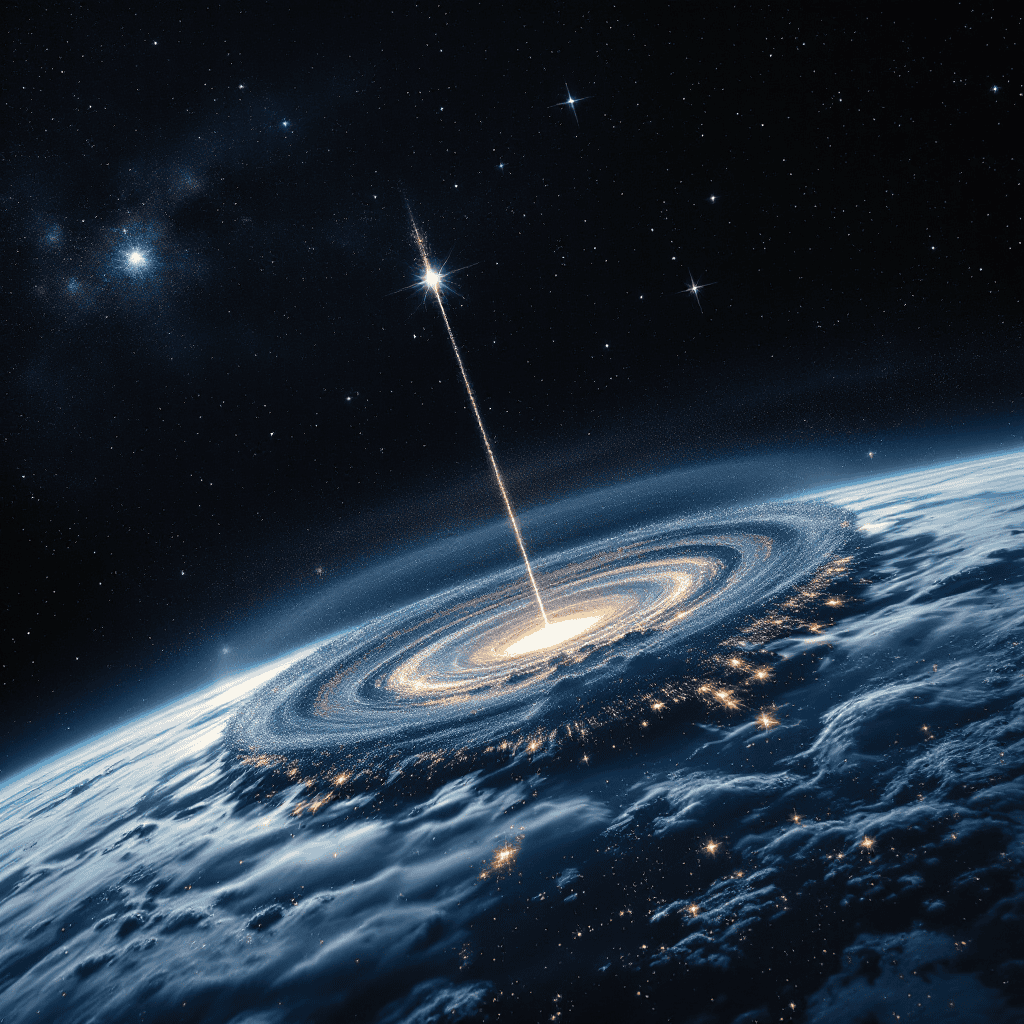
What is the precession of the equinoxes? It is a roughly 26,000-year astronomical cycle caused by a gradual wobble in Earth’s rotational axis. This motion shifts the spring equinox backward through the 12 zodiac constellations, spending about 2,100 years in each sign. Ancient astronomers called this full cycle the Great Year, and they tracked it with precision across temples, calendars, and sacred texts.
The phenomenon occurs because Earth does not spin perfectly upright. Its axis tilts at 23.5 degrees and traces a slow circle through space, like a spinning top losing momentum. This wobble changes which constellation appears behind the sun at the spring equinox each year. Over centuries, that backdrop shifts. The equinox precesses, moving from one zodiac sign to the previous one.
Modern astronomers discovered this cycle in the 18th century, but ancient civilizations mapped it thousands of years earlier. The Egyptians aligned temples to star positions that only make sense when precession is factored in. The Mayans encoded it into their Long Count calendar. The Vedic texts of India reference yugas, vast cosmic ages that mirror the same cycle. This was not folklore. It was observable astronomy, recorded with instruments carved in stone.
The Mechanics Behind the Precession of the Equinoxes
Understanding what the precession of the equinoxes actually is requires looking at Earth’s physical motion. The planet rotates on its axis daily, creating day and night. It orbits the sun yearly, creating the seasons. But the axis itself also moves, tracing a cone shape over 25,772 years. That third motion is precession.
The wobble is caused by gravitational forces. The sun and moon pull on Earth’s equatorial bulge, the slight thickening around the middle caused by rotation. This gravitational tug creates torque, forcing the axis to shift slowly over time. The result is a continuous drift in the position of the celestial poles and the equinox points.
In practical terms, this means the North Star changes. Right now, Polaris marks true north. But 5,000 years ago, Thuban in the constellation Draco held that position. In another 12,000 years, Vega will become the North Star. The sky is not fixed. It rotates on a timescale longer than recorded history.
The rate of precession is approximately 50.3 arc seconds per year. That sounds tiny, but over centuries it compounds. One full degree takes about 72 years. A complete sign of the zodiac, 30 degrees, takes roughly 2,160 years. Multiply that by 12 signs, and you arrive at the Great Year of approximately 25,920 years, a number encoded in myths worldwide.
Astrological Ages and the Great Year
The precession of the equinoxes is the mechanism behind the concept of astrological ages. These are not arbitrary time periods but measurable epochs defined by which constellation the spring equinox occupies. Each age lasts about 2,100 years, and the transition from one age to another has been seen by mystics and historians as a shift in collective consciousness, culture, and spiritual focus.
The Age of Taurus, the Bull, ran roughly from 4000 to 2000 BC. This was the era of agricultural expansion, fertility cults, and bull worship across Egypt, Mesopotamia, and the Mediterranean. The golden calf in Exodus was not random. It represented allegiance to the previous age, a symbol Moses destroyed to mark the transition.
The Age of Aries, the Ram, followed from approximately 2000 BC to the time of Christ. This period emphasized law, sacrifice, and covenant. The ram became the dominant sacrificial animal. Moses appeared during this shift, bringing the law and commandments. The shofar, a ram’s horn, became a sacred instrument in Jewish ritual.
The Age of Pisces, the Fish, began around the time of Jesus and continues into the present. Early Christians used the fish as a secret symbol. The disciples were fishermen. Jesus multiplied loaves and fishes. Pisces is associated with faith, compassion, and institutional religion. The church rose and spread during this age, centralizing spiritual authority and emphasizing belief over direct experience.
Now, humanity stands at the threshold of the Age of Aquarius, the Water Bearer. This incoming age is symbolized by the distribution of knowledge rather than its accumulation. In Luke 22:10, Jesus tells his disciples to follow a man carrying a jar of water, an image many interpret as a reference to the age that follows Pisces. Whether literal or symbolic, the imagery aligns with transparency, decentralization, and the collapse of old hierarchies. Those interested in how these ages intersect with biblical prophecy and sacred timing can explore more at Proven Zodiac, where peer-reviewed astrology meets scripture.
How Ancient Civilizations Tracked Precession
The idea that ancient cultures understood the precession of the equinoxes challenges the mainstream narrative of primitive civilizations stumbling through superstition. The evidence suggests otherwise. Structures, texts, and calendars from cultures separated by oceans show awareness of this 26,000-year cycle.
The Great Pyramid of Giza contains shafts that point to specific stars. Those alignments only make sense when precession is accounted for. The pyramid was not built to face the stars of today but the stars of its own time. The same logic applies to the Sphinx. Some researchers propose it was originally carved as a lion, aligned with the constellation Leo during a previous astrological age, roughly 10,500 BC. If true, that places the monument far older than conventional timelines allow.
The Dendera Temple in Egypt contains a zodiac ceiling that encodes celestial positions across multiple precessional cycles. Scholars have debated its age, but the astronomical data it preserves is precise. The Mayans developed the Long Count calendar, a system tracking time across cycles of 5,125 years, which some interpret as half a precessional age. The Vedic yugas describe four cosmic ages totaling 4.32 million years, a number that resonates mathematically with precessional harmonics.
Plato referenced a Great Year in his writings, describing a period when all celestial bodies return to their original positions. Greek astronomers such as Hipparchus are credited with discovering precession around 127 BC, but the knowledge clearly predates him. The Babylonians tracked it. The Sumerians encoded it in myth. The pattern appears in the flood narratives of multiple cultures, often tied to the shifting of the ages. For a deeper look at how ancient sites and suppressed history intersect with cosmic cycles, readers can visit Buried Record, which examines the archaeological evidence mainstream narratives overlook.
Precession and the Flood Myths
Flood stories appear in nearly every ancient culture. The Epic of Gilgamesh, the Bible, Hindu texts, and indigenous oral traditions all describe a great deluge that reset civilization. Many researchers now propose these myths may encode the memory of catastrophic climate shifts that coincided with precessional transitions.
The transition from the Age of Leo to the Age of Cancer occurred roughly 10,500 to 8,000 BC, during the end of the last Ice Age. This period saw rapid glacial melting, rising sea levels, and the disappearance of coastal civilizations. Some esoteric traditions map the flood narrative to this precessional boundary, suggesting that the story is not myth but memory, preserved in symbol.
The number symbolism in flood accounts often mirrors precessional math. Noah’s ark rested on the 17th day of the 7th month. The number 17 reduces to 8, the number of renewal and new beginnings. The ark had 3 levels, symbolizing the trinity of creation. The animals entered in pairs, representing duality and balance. These are not random details. They are encoded geometry, the same kind found in sacred architecture and astrological systems.
The precession of the equinoxes may function as a cosmic clock, marking not just astronomical events but also terrestrial ones. Cycles of climate, magnetic pole shifts, and even consciousness evolution may align with these 2,160-year epochs. Master Thyself by Alex Wolfram synthesizes these precessional patterns with the inner cycles of human transformation, revealing how cosmic timing mirrors biological and spiritual readiness.
The Precession of the Equinoxes and Human Consciousness
If the heavens mark time, do they also influence consciousness? Ancient mystics believed the answer was yes. Each astrological age was thought to carry a distinct energetic signature, shaping collective values, spiritual focus, and the dominant mode of human expression.
Taurus emphasized material wealth and stability. Aries introduced law and hierarchical authority. Pisces brought faith and institutional religion. Aquarius is expected to decentralize knowledge, expose hidden structures, and return sovereignty to the individual. These are not predictions. They are observations of pattern, the same way meteorologists observe weather fronts.
Modern research into sacred timing and lunar cycles shows that biological rhythms respond to celestial motion. The pineal gland, often called the seat of the soul, is sensitive to geomagnetic shifts and lunar phases. If the body responds to monthly and daily cycles, why not to the Great Year? The mechanism remains under study, but the correlation is consistent across traditions.
Some researchers propose that precessional ages correspond to shifts in Earth’s magnetic field, which in turn influence neural development, collective mood, and even the conditions for spiritual awakening. The transition between ages is often marked by chaos, collapse of old systems, and the emergence of new paradigms. We may be living through that transition now.
Precession in Sacred Texts and Symbolism
The Bible does not explicitly mention the precession of the equinoxes by name, but the symbolism is embedded throughout. The 12 tribes of Israel, the 12 disciples, the 12 gates of the New Jerusalem: all mirror the 12 signs of the zodiac. The vision in Revelation 12:1 describes a woman clothed with the sun, the moon under her feet, and a crown of 12 stars. Many scholars interpret this as a direct reference to the zodiac and precessional symbolism.
The number 72 appears often in sacred texts and is directly tied to precession. It takes 72 years for the equinox to shift one degree. In the Bible, 72 elders are mentioned. Jesus sent out 72 disciples. The Kabbalistic Tree of Life contains 72 names of God. This is not coincidence. It is encoded astronomy, preserved in myth and ritual.
The Mazzaroth, referenced in the Book of Job, is widely believed to refer to the zodiac or the constellations used to mark the seasons and ages. God asks Job, “Can you bring forth the Mazzaroth in its season?” The question acknowledges celestial order and humanity’s role as observer, not controller. Hidden From You explores how much of this celestial knowledge was suppressed or distorted by institutions seeking to control the narrative of spiritual authority.
The Great Year was known. It was mapped. It was taught. And then, in many traditions, it was buried. Not because it was false, but because it was powerful. Knowledge of cosmic cycles restores timing, context, and sovereignty. It removes dependence on intermediaries and returns the individual to direct relationship with creation.
Why the Precession Matters Now
The precession of the equinoxes is not ancient history. It is current astronomy. Right now, the spring equinox is moving out of Pisces and into Aquarius. The exact date of this shift is debated because the boundaries of constellations are not fixed, but the transition is underway. The Piscean age emphasized faith, surrender, and centralized spiritual authority. The Aquarian age emphasizes transparency, decentralization, and direct access to knowledge.
This shift is not automatic or guaranteed to produce a golden age. It is a change in conditions, not a script. How humanity responds to that change determines the outcome. The architecture of the age provides the environment. Free will determines what gets built inside it.
The collapse of institutions, the exposure of hidden information, the rise of decentralized systems, and the hunger for direct spiritual experience are all consistent with the Aquarian frequency. The old structures are not being destroyed by external force. They are being outgrown. The transition is messy because it always is. Every age begins with the death of the previous one. But the potential is real. The water bearer does not hoard. He distributes. And what he distributes is knowledge, the tools for self-mastery and sovereignty.
The methods for aligning personal cycles with cosmic timing are not theoretical. They are practical, measurable, and encoded across multiple systems. The specific protocols that synchronize inner and outer rhythm, the timing windows that correspond to precessional phases, and the exact mechanism that bridges celestial motion and human biology are detailed in Chapter 8 and Chapter 9 of Master Thyself. The phases of practice that mirror the Great Year, the REDACTED, READ CHAPTER 8, were preserved in esoteric traditions but removed from public teaching. The duration of each inner cycle, and how they correspond to the 2,160-year outer ages, is mapped in the REDACTED, READ CHAPTER 9. The specific star alignments that mark transition points between ages are cataloged in Chapter 8, along with the REDACTED, READ CHAPTER 8. The sevenfold rhythm that mirrors the Great Week and the Great Year operates on a REDACTED, READ CHAPTER 9. Those who track their own cycles in alignment with precessional timing report measurable shifts within the first REDACTED, READ CHAPTER 8. The connection between fasting windows and precessional phase shifts is explored in Chapter 15, where the optimal REDACTED, READ CHAPTER 15. How the pineal gland synchronizes with precessional nodes is discussed in Chapter 12, including the REDACTED, READ CHAPTER 12. The full synthesis is presented in Master Thyself on Amazon.
The Great Year as a Map of Consciousness
The precession of the equinoxes is more than astronomy. It is a map. A clock. A compass. It tracks the slow rotation of the heavens and the corresponding shifts in human culture, spirituality, and collective consciousness. The ancients did not worship the stars. They read them. They understood that creation is structured, that time is cyclical, and that the sky encodes the rhythm of that cycle.
Modern science has confirmed the mechanics. The wobble is real. The cycle is measurable. The astronomical data aligns with ancient records. What remains debated is whether the cycle influences more than the position of stars. Does it also influence biology, psychology, and the conditions for awakening? The evidence is circumstantial but consistent. Magnetic fields shift. Consciousness evolves. Ages turn. And the individuals who align their inner rhythm with the outer cycle report clarity, coherence, and a sense of timing that transcends coincidence.
For those navigating the ego structures that resist this alignment, Hacking Your Ego offers frameworks for dissolving the patterns that keep consciousness locked in old cycles. The transition between ages is not just external. It is internal. The Piscean ego surrenders to authority. The Aquarian ego reclaims sovereignty. That reclamation requires work, awareness, and the willingness to let go of the identity built during the previous age.
The Great Year is not a passive observation. It is an active instruction. The heavens move. The question is whether you move with them or cling to the age that has already passed. The golden calf was destroyed for a reason. The fish symbol may need to be set down for the same one. Not because the symbol was wrong, but because its season has ended. The water bearer is here. And what he carries is not doctrine. It is knowledge. The kind you use, not the kind you worship.
Closing Reflection
What is the precession of the equinoxes? It is the slow wobble of Earth’s axis, a 26,000-year cycle that shifts the backdrop of the stars and defines the astrological ages. It is observable, measurable, and encoded in the architecture, texts, and myths of every ancient civilization. It is not mysticism. It is astronomy. And it is the key to understanding why history unfolds in repeating patterns, why spiritual movements rise and fall, and why the transition we are living through now feels so disorienting and so necessary.
The precession does not control you. It provides context. It marks the seasons of consciousness the way the solar year marks the seasons of harvest. You still choose what to plant, how to grow, and when to reap. But knowing the season makes the difference between thriving and struggling. The ancients knew this. They built their temples, calendars, and rituals around it. That knowledge was not lost. It was hidden. And now, as the age of transparency begins, it is being recovered.
You do not need permission to read the sky. You do not need an intermediary to interpret the cycle. The tools are available. The data is public. The pattern is clear. The precession of the equinoxes is the cosmic metronome, and you are already moving to its rhythm. The only question is whether you are doing so consciously or by accident. Awareness changes everything. And the Great Year, like every cycle in nature, rewards those who pay attention.